Showing posts with label Technology. Show all posts

Tuesday, February 25, 2014

Technology and Information in SCM

In today’s world, where the market is ever more competitive and aggressive, and customers are more and more demanding in terms of product quality, corporations cannot do without information technology in their supply chain. Generally, technology has affected supply chain management at least in two ways: by increasing the quality of service offered to customers, and by decreasing inventory costs, and consequently the entire supply chain costs [1].

Customers these days are used to performing orders online in a matter of minutes: they can choose the product they want, pay for it electronically, they can see when their orders are being processed, when the items are being shipped, they can see the expected delivery date and they can track shipments. None of this would be possible without proper investments in information technology, and if companies want to retain their customers, they have to be able to offer such service, or buyers, who rightly love this service and expect it from sellers, will simply flee to the next online vendor. Companies like FedEx and UPS have not only embraced these technologies, but they actually contributed to developing them, and they are in fact leaders in the shipping industry [2].

Moving on to see how IT has helped in cost reduction, consider inventory costs. Inventory management has taken advantage of the utilization of technologies such as barcode and RFID. RFID allows for a surprising cut in time needed for inventory cycles: what used to take days of work, and was only doable 2 or 3 times a year, can be done today on a daily basis. This technology also permits to perform an accurate re-ordering strategy, that cut inventory costs [3]. The barcode is another helpful technological support for managing customers’ checkout process in stores. A new type of barcode, the stretched barcode, has enhanced the checkout process even more, increasing customers’ satisfaction (Trader Joe’s) [4].

Cost reduction is also brought about by an efficient communication across different sectors of the supply chain. If a problem arises at one particular stage, the adjacent stages will be directly affected too. Similarly to Just-In-Time (JIT) strategies for inventory management, efficient and timely notification strategies, such as automated alerts via email or text message, will circulate information in real time and allow for interventions when and where needed [2].

Is information technology the real asset to rely on though, when it comes to efficient supply chain management? Is it really technology that we have to acknowledge for the progress made in these 30 years or so of the recognition of supply chain management as a field of its own? And is it really technology that we have to count on in order to move forward? Isn’t the greatness of human minds that first envisioned and then developed such technologies that we should be thanking for the wonders they created and will be able to create in the future [5]? The man before and beyond the machine, so to speak.


References


Tuesday, February 18, 2014

Augmented reality- WEAR it to WARE it !

So, what does the title mean? Read on to understand:
As kids, most of us wanted to be pilots flying those supersonic planes and air force jets in high speed and look through the fantastic view through the cockpit. But had we ever really seen the importance of the real time communication between the command center and the pilot? Had we thought of what would happen if we did not get the instantaneous information about a malignant object that could strike us in seconds? Not really! We often ignore the importance of being connected! This aspect has been improved upon using latest technology in recent times with the help of augmented reality. This cutting edge technology has been emerging fast and has found its application in various segments of business and consumers. Google glass has been a pioneer product in this area so far and lot of new companies are coming up with wearables.

What on earth is google glass? And where can I see it?
Google/Smart glass is a groundbreaking device that uses this technology which has been proven very valuable in various important domains including healthcare. Next time you walk into a hospital, you can see a nurse wearing smart glasses to check the route plan which is directly displayed and setting off her medication tray. Then she goes into the patient’s room and scans the barcode on his wristband using her glasses and receives information about what medication that particular patient is supposed to take at that moment. She can clarify any questions regarding the medication, dressing or the patient’s condition with a physician immediately through her glasses. At the end of day, all this information is fed into the patient’s electronic health record and the hospital IT system is updated with latest information of the warehouse of medicines, inpatient and outpatient records and the number of available beds etc.


Where else can this be used?

This technology of smart glass has been successfully implemented in one of the company warehouses in Austria. Knapp AG is a material handling and logistics software solution provider in Austria who developed augmented reality glasses using KiSoft Vision solution which is analogous to voice recognition but here, the prompts are visual as opposed to audio. These glasses are used in their warehouse to pick up products, sort them and replenish in a faster and easier way. Wearable glasses are better than the voice solutions because pallet building optimization works better with it. Pallet building optimization is based on showing the worker how to stack the cases on a pallet to maximize cube and ensure light items are safe and meeting case grouping objectives. Especially it is useful where the items require a lot of scans and too many serial codes are involved. This video shows how the smart glass has improved warehouse management at Knapp AG.

So what? How is this useful for supply chain management?
There’s work being done in this technology so that apps can be developed which can be connected with the smart glass and a layer can be developed in the realm of supply chain by integrating live data, social media about real objects, places, cartons, pallets, trucks and staff to spare parts, warehouse, deliveries and ultimately, the consumers. With these apps, it will be easier to collaborate with anyone and everyone in the entire supply chain and make decisions in real-time. Gone are the days when we could know when and where the item is out of stock; now it’s time to know why an item is out of stock! The main issue with supply chain management is that almost 80% of the data relating to the supply chain is external to each entity. It’s with different companies, on different systems and different formats. This makes the supply chain a group of individual silos making it hard for us to integrate. Google glass/ augmented reality solves this problem by making the supply chain a seamless flow of vital information in real time.  

Can you give a real world example? Again, how does this work?
Imagine yourself as one of the logistics planning manager in an enterprise: You are waiting for a truck which is running an hour late already and the manufacturing department manager is expecting the material from you right now! On the other hand, the customer wants his order delivered tomorrow! On top of all this, you have an important meeting which will run for another hour,that you can’t miss. You do not have any further information on any of the problems and how to solve them. Now imagine, you walk into the meeting room and wear you smart glasses and you can see the picture of the truck and you have the current expected arrival time based on the real-time traffic density and through your glasses you can update this information on the other IT systems such as the manufacturing department and the CRM etc. so that necessary arrangements can be made. Isn’t your life beautiful now?


Versatility: There’s work being done on building an enterprise app-store which can be used similar to an Apple or Android app store with wide range of business applications that can be used on the versatile Google glass platform. This could be a huge opportunity for both established software supply chain vendors and emerging software companies. These apps are created by various vendors such as enterprise software vendors, niche players with expertise in specific planning or scheduling software, middleware vendors and most importantly the cloud vendors! With the help of these apps and the Google glass platform, valuable data sources over the extended supply chain and external data sources such as weather, traffic, DHL etc which will enrich existing data the business operation on a global level can be carried out with mind boggling accuracy. Costs can be reduced, go-to-market can be accelerated and ultimately, quality and customer loyalty can be improved drastically by using the appropriate tools that this era of commercial revolution has to offer us!

Do you think augmented reality can help improve the global supply chain? I would love to hear your thoughts!! J


References:
1)http://logisticsviewpoints.com/2013/02/11/google-glass-augmented-reality-and-the-warehouse/
2)http://www.supplychaindigital.com/outsourcing/post
3)http://www.supplychain247.com/article/google_glass_augmented_reality_and_the_warehouse
4)http://teamstersonline.com/forums/spaghettis-world/46352-augmented-reality-supply-chain-warehouse-management.html

Sunday, February 16, 2014

RFID: small thing, LARGE VALUE

Walmart, known for its operational efficiency was one of the first to use the small rfid (Radio Frequency Identification) chips drive large BUSINESS VALUE. Following is a summary of how it has benefited from RFID over the years.

Initially, Walmart used RFID to track its goods at various stages of the supply chain. This helped them defined and measure metrics to analyze how long does it take them to make a product available on the shelf once it has been purchased and stored in a warehouse. This also allowed them to see how quickly their inventory is moving physically. To make this more effective, Walmart collaborated with its suppliers and ensured that they adopt RFID too. This took the RFID initiative to a whole new level where information now being captured outside Walmart's own control.


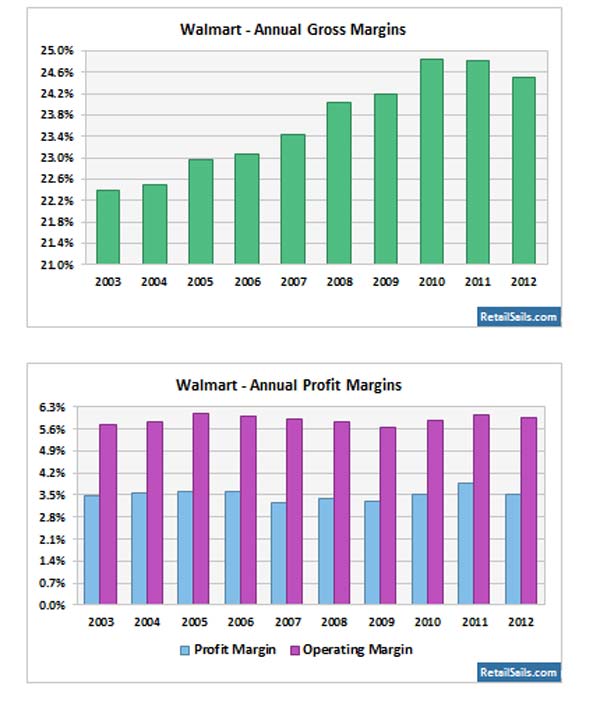
By 2007, executives at Walmart were able to reduce their inventory levels and thereby improve the bottom line. As seen in the below graphic, Walmart annual gross margin improved dramatically after 2007.

Later in 2010, Walmart replaced the barcodes on garments with RFID. The fact that RFIDs can store more information than barcodes which can be used for real time analytics prompted this decision. An additional advantage was that they can be scanned by a distance and without a clear line of sight. This reduced the time to capture the information stored. This reduced lag in information helped the executives at Walmart make informed decisions quicker than before. A detailed explanation of the garment RFID process at Walmart is depicted in the below diagram. It also highlights a few of the privacy concerns with the use of this technology and how Walmart has worked around them.


In addition to Walmart, Harley-Davidson, Toyota and Las Vegas airport (baggage department) have also deployed RFID across their supply chains. Thus, it is reasonable to conclude that fast capture and analysis of supply chain information can generate great business value to organizations across all industries, irrespective of their size. But how large a company needs to be before investing in these technologies is a food for thought.

Tuesday, February 4, 2014

Walmart: technology and inventory.

Theme of the week of our Supply Chain Management course is “Inventory.” Inventory management is a crucial step for the entire SC of a company. Its goal is to fulfil suitable levels of customer service while keeping inventory costs within reasonable boundaries.

Focusing on the inventory, Walmart has been able to stand out among similar stores, becoming “the world’s largest and arguably most powerful retailer with the highest sales per square foot, inventory turnover, and operating profit of any discount retailer (see here).”

A considerable percentage of its success is based on technology, starting back in 1975, with the first utilization of an electronic cash register, which was able to keep track of each purchase, providing a constant update of the inventory. In 1983 came the bar code for scanning POS (point-of-sale) data. After almost 20 years, RFID (radio frequency identification) technology literally revolutionized Walmart’s inventory management.

Let’s start with the introduction of bar codes. With the utilization of barcodes, Walmart was able to track “what is being sold … [and] what prices are popular” (see here) obtaining competitive advantage and leverage over its suppliers. As pointed out in the article mentioned above, Walmart’s strategy was quite powerful: 'We want to sell this at a certain price. You make it at a certain price, or we're not going to work with you.' This approach affected Walmart’s SC in two ways: it allowed them to buy products at a lower price and to revise the inventory based on customers’ demand (stocking up on products loved by customers while reducing the not-so-loved ones).

Then, in the early 2000s, RFID technology burst into the scene and immediately had a strong effect on Walmart’s inventory management. The technology was able to identify and track any object, transferring its information from the tag directly to the biggest and most powerful computer in the world involved in inventory management. In this way, there was a substantial  cut of “the volume of excess inventory in Walmart’s massive supply chain,” “by almost one-third,” according to this article, thus decreasing the inventory costs. 
                                                                                                      
What other technology will Walmart embrace in the next future in order to maximize the result of its SC? Walmart knows the products that its customers buy now, so it might focus on what its customers would like to buy tomorrow.


References:


Sunday, September 8, 2013

How RFID has changed the landscape of SCM?

The supply chain management has been focusing on squeezing cost and improving operations for decades. In the 1980s, there was a lot of focus on just-in-time production, lean manufacturing and discrete systems. In the recent decade, the obsession about high quality goods, cost minimization and flawless distribution has been made possible by the advancement in technology. 
Radio Frequency Identification (RFID) technology, as a part of a broader spectrum of sensor-based technologies, has dramatically revolutionized the supply chain management. Basically RFID is simply an enabling technology that has the potential of helping retailers provide the right product at the right place at the right time, thus maximizing sales and profits. RFID provides the technology to identify uniquely each container, pallet, case and item being manufactured, shipped and sold, thus providing the building blocks for increased visibility throughout the supply chain. 
RFID is a system of small electronic tags (comprising a tiny chip plus an antenna) that transmit data via a radio signal to RFID readers and related hardware and software infrastructure. The information on tags is read when they pass by an RFID reader, and that movement is captured and managed by the infrastructure. The direct and swift interaction between the tags attached to goods and the information reception center has greatly reduced the fatigue of manually tracking goods along the supply chain. This technology has been widely applied to various industries including retailers, distributors, logistics service and pharmaceutical companies etc. Professor Phillip J. Windley at Brigham Young University estimated that US retail giant Walmart alone could save $8.35 billion annually with RFID - that's more than the total revenue of half the companies in the Fortune 500! 
Thousands of inbound and outbound shipments can be identified by RFID labels which enables 100% inventory visibility and unattended sortation of goods at different points of the supply chain. The following image visualizes the way RFID works in the products manufacturing period.
Source: Zebra Technologies
On top of the theories and cases on the textbooks, I've personally experienced the power of RFID when I shopped at one of Zara's retail stores in Spain. The blue dress in my size was sold out in the store, so I asked the salesperson to check their inventories in the warehouse. I thought it would take at least 15 minutes for them to figure it out, but the item was accurately located by the system in less than 5 minutes. More surprisingly, the salesperson helped me place an order right away and delivered the dress to my door very next day. When I felt puzzled about the high efficiency, I searched online and found the secret behind Zara's amazing customer service - RFID. One of RFID’s most attractive offerings is its fundamental attribute of not requiring line-of-sight when reading RFID tags. This means items do not require particular orientation for scanning, unlike barcodes. 
Obviously RFID has many other advantages such as labor reduction, cost cutting and durability, but it's also faced with many pressing issues such as lack of standards and potential privacy loopholes. In the long run, technologies including RFID will continuously drive and maximize supply chain management, but key issues need to be addressed to bring the supply chain management to a higher level of success. 

Monday, September 2, 2013

Information Technology and forecasting in SCM

-Zhou (Joe) Ye

As we learnt in the first class, supply chain is flows of products, funds and information. And information is also one of the four drivers of supply chain. The second week's class is about forecasting. I'm quite interested in how information technology optimize supply chain management by making forecasting.

That's exactly how SCM is empowered by SAP, where I worked in the past 5 years. As an ERP solution provider, SAP focuses on collecting information from every aspect of business, modeling the business process and centralizing the whole enterprise management with its software solution. Supply chain management has always been the most important section in enterprise resource planning, especially for manufacturing business.

The SAP SCM module models the real supply chain processes into information system. It keeps collecting data from inventory, processing time, transportation cost, etc. Special algorithms are implemented in the software performing business intelligence functions to identify the bottleneck and issues in the whole process on the early stage by forecasting the potential consequences and send warnings to management team. (1)

Modern supply chain management is a very good example of combination of business and technology.I’ll try to incorporate my IT background into the study of SCM and make further inputs here.

______________________
(1) G. Knolmayer, P. Mertens, A. Zeier - Supply Chain Management Based on SAP Systems. Springer

Tuesday, November 29, 2011

3-D Printing Revolutionizes Production Of Quality Assurance Materials In Auto Manufacturing


RapidFit+ (a product of Materialise) has used 3-D printing technology to transform the quality assurance process for manufacturers, enabling the production of previously difficult or even unthinkable designs and making the entire process cheaper, faster and more responsive to design changes.

I believe that this technology has been primarily used in the automotive industry, so far. In these supply chains, smaller manufacturers produce parts that are put into larger parts by other manufacturers, which may be added to even larger components by another manufacturer, and so on until the final components are installed by the automaker in a vehicle. These supply chains can be incredibly complex, and if one manufacturer anywhere on the chain produces parts outside of a very strict set of specifications the whole system quickly falls apart.

In the past, individually machined (and very expensive) aluminum or steel relief-molds were used by manufacturers to check the accuracy of parts being produced. When a part was produced, it could be slipped into the mold and checked for accuracy. Today, the introduction of new hyper-precise 3D printing technology and the ubiquity of the Internet mean that custom 3D printed objects can be used to verify parts as they move though the manufacturing process.

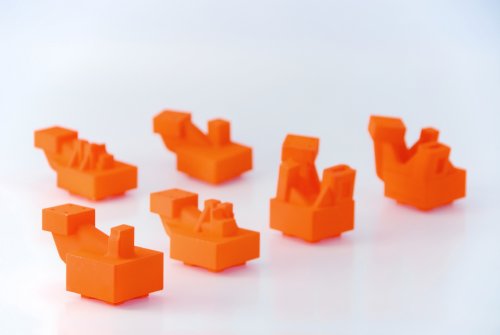
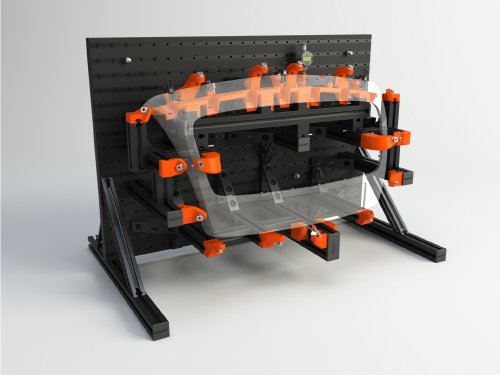
At RapidFit+, an original equipment manufacturer (OEM) can use an online platform to upload 3D and engineering data who then works out a precise rig that can accurately check the dimensions of the finished part within +/- 0.05 mm. At any time the OEM can use the online platform to approve the design or make changes to the parts if necessary. Once approved, a fixture is produced and the precision calibration units are 3-D printed (These are orange things you see in the photo at the top of this post.) and sent to the part manufacturer.

This technology brings numerous advantages to the supply chain. As previously stated, these quality assurance rigs were traditionally made from a solid block of metal. Aside from the huge expense of creating it, these rigs were only accurate for a single part, possibly on a single model of car. With the adoption of 3-D printing, adjustments can be made when small changes are ordered, or for similar parts between different models. Further, these new quality assurance rigs can be produced cheaply, quickly, durably (tests have shown that even after 10,000 cycles wear is limited to only a few microns) and as previously stated the OEM can send design changes in real time. And because the rigs are built on a modular structure, and only the precision "locators" are custom printed, a rig can be configured in multiple ways for multiple parts depending on needs of the part manufacturer.

Currently, RapidFit+ uses this technology in-house, but it is not impossible to see a future where individual part manufacturers invest in 3-D printing technology and their customers are able to upload design specifications directly.

Question: Within the field of supply chain management, for what other applications could 3-D printing technology be suitable?

RapidFit+ using 3D printing to check mass produced parts