Showing posts with label Demand Forecasting. Show all posts

Monday, January 20, 2014

Amazon to Apply Demand Forecasts to the Delivery Process

Amazon invests huge amounts of capital in research and development to reduce costs and gain efficiency in the largest part of their supply chain, delivery to the customer. Although most of us have read and heard jokes about the recent Amazon press on their development of delivery drones, another innovation coming out of Amazon R&D has flown under the radar (pun intended). The giant corporation has now successfully patented a “method and system for anticipatory shipping.” In other words, in order to cut down on the time period between when a customer purchases an item online to when it is received through the mail, Amazon is experimenting with beginning the first steps of the shipping process before the item is even purchased. Using the metadata Amazon collects on its customers (things like how long you hover your mouse over an item), they have developed algorithms to predict when it is likely for customers in particular geographical areas to purchase particular products. The products will be packaged for home delivery and sent to the targeted geographical hub, before a specific physical address is labeled on the package (since the customer hasn't actually ordered anything yet).

This idea is in the beginning stages of experimentation, but will be interesting to watch develop. Typically, demand forecasting is used to make decisions on inventory. Amazon is trying to take demand forecasting a step further and apply it to the delivery process as well. If successful, we may see other large online shops begin to apply customer data in similar ways. However, Amazon has a competitive advantage in their access to mindboggling amounts of customer data to use in their predictive modeling.

Do you think preemptive shipping will reduce delivery times? Will an improvement in shipping efficiency increase Amazon’s revenue?

Patent Abstract:
“A method and system for anticipatory package shipping are disclosed. According to one embodiment, a method may include packaging one or more items as a package for eventual shipment to a delivery address, selecting a destination geographical area without completely specifying the delivery address at time of shipment, and while the package is in transit, completely specifying the delivery address for the package.”

Sources:
Patent:
http://pdfpiw.uspto.gov/.piw?Docid=08615473&homeurl=http%3A%2F%2Fpatft.uspto.gov%2Fnetacgi%2Fnph-Parser%3FSect1%3DPTO2%2526Sect2%3DHITOFF%2526p%3D1%2526u%3D%25252Fnetahtml%25252FPTO%25252Fsearch-bool.html%2526r%3D1%2526f%3DG%2526l%3D50%2526co1%3DAND%2526d%3DPTXT%2526s1%3D%252522anticipatory%252Bpackage%252522%2526OS%3D%252522anticipatory%252Bpackage%252522%2526RS%3D%252522anticipatory%252Bpackage%252522&PageNum=&Rtype=&SectionNum=&idkey=NONE&Input=View+first+page

Monday, September 16, 2013

Target wrongly estimates demand forecast

This blog is based on the article that I had come across relating to weekly readings, inventory management and demand forecasting.

In the year 2011, Target decided to launch Missoni products at their store and online. Missoni, an Italian fashion brand is well known for its knitwear design and it is a much sought after brand among customers. But, when Target released Missoni’s products online and in-store, the demand for the product immediately skyrocketed and Target was left with very limited inventory to tackle this sudden rise in demand for Missoni products.

The reason for this debacle is very simple: Target did not forecast demand well enough for Missoni products. As Target couldn't meet the demand, scalpers made use of this opportunity of by selling products at a much higher rate. In one such case, a Missoni bicycle priced at $399 was sold on eBay at a ‘buy it now’ price of $1600. Another case was that an enterprising seller was willing to pay $31,000 for a pair of Missoni Venetian Rain boots, size 10.The second largest discount retailer in the United States, faced strong criticism for failing to fulfill orders it accepted online. Some cases of severs crashing were also reported. Customers even had the tracking number of their packages when UPS did not have any record of such packages. 

The problems faced by Target were due to miscalculation of forecasting demand by a great margin and poor execution of their product launch. Target could have had some of the Missoni products in excess as a buffer in their storage to better tackle this situation and optimize their profits. Even though errors in demand forecasting is inherent and in very rare cases could one make an exact prediction of demand for their products, Target could have done a better job in minimizing errors by getting close to customers and estimate the demand for Missoni products. Being close to consumers rather being farther up the supply chain could have eliminated the large distortion of demand related information it had received. Another method the demand forecasters could have done is to compare how other big retailers such as Walmart have handled such a situation and steps could have been taken in a similar manner to avoid this problem.

Due to the Missoni launch fiasco, Target would have difficulties wooing other big designers to their product line. What measures could Target undertake to estimate the demand for a product they are about to launch (for instance: other big designers or any other much sought after brands) to their product lineup?

Source:

Friday, February 3, 2012

Predicting the Unpredictable: Challenges of Planning Demand and Supply of LPG in Indonesia


These are some of the headlines from local news in Indonesia for the past couple of days:

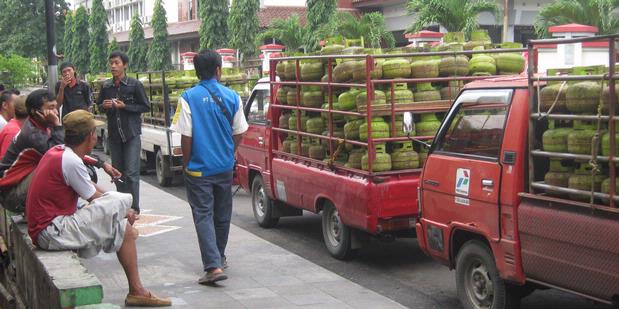
LPG sub-agents queuing at LPG distributor agents in Kendal, Central Java (via kompas.com)

From Kerosene to Liquefied Petroleum Gas (LPG)

Over US$6 million is budgeted by the Indonesian government every year to subsidize oil fuel in the form of kerosene, low-octane petrol, diesel fuel and LPG for household consumers. Kerosene receives the largest amount of subsidies (over 50% of the budgeted funds for oil fuel is spent for kerosene).

Kerosene is majorly used by lower class household consumers in rural areas of the country, in which  the population is mostly composed of. Most of them relied on kerosene as a main source of fuel for cooking because it is cheap. Since it is affordable, people became dependent on kerosene. This is causing trouble for the government because global oil prices are rising and consequently inflating the government's budget.

As a solution, in 2007 the government established a program to convert household consumers from using kerosene to LPG. LPG is also subsidized, but not as much as kerosene. In short, the government can save a lot of money by diverting household consumption to LPG.

Apart from that, converting to LPG triggers the growth of equipments industry for LPG related appliances, such as stoves and gas cylinders. Growth of industry means growth of employment, which subsequently helps the economic development.

Kerosene to LPG conversion program (via pertamina.com)


Challenges in Supply Chain

5 years since the deployment of the kerosene to LPG conversion program, problems are starting to arise. Pertamina (State Oil and Natural Gas Mining Company), as the sole producer of LPG in Indonesia, are facing problems in their supply chain. As described in some of the news headlines, LPG in some areas of the country are scarce. Demand for LPG in these areas are not fulfilled.

Looking at some of the areas mentioned above, they are not concentrated in a particular region of the country. Majalengka and Kendal are both located in the populous island of Java. Majalengka is a regency located in the western part of Java, while the location of Kendal is in the central. Lombok and Palopo on the other hand, are located in the eastern area of Indonesia, which is not as populous as Java. Lombok is an island in the south east of Indonesia, while Palopo is a regency in the island of Sulawesi in the north east. This shows that location has little to do with the shortage of supply in LPG.

One area of supply chain of LPG that are facing some problems is shipment. In the case of Lombok and Palopo, bad weather was the main reason for the insufficient supply of LPG to those areas. Ships were unwilling to sail because it was too risky. Pertamina did not anticipated the interruption of shipment, as a result, LPG in Lombok and Palopo were short in supply because the stock of LPG in these areas were depleted while demand were constantly growing.

In the case of Kendal, one of the reasons for the lack of LPG mentioned in the article was the sudden increase in demand. At one point, plenty of people were using wood to cook. Then came the rainy season. Those who were still using wood to cook are now finding it hard to find dry wood to burn. Because of that, they had to switch to LPG. In this case, weather did not interrupt the shipment process. However, it suddenly increased the demand for LPG, while the amount of stock of LPG did not change.

Two large tankers filling up petrol and LPG at one of Pertamina's depot in Tanjung Uban, Bintan island, the province of Riau islands. Petrol and LPG from this depot are shipped and distributed to the island of Java. (via antarafoto.com)


Forecasting is key

Planning demand and supply in a supply chain is vital. Pertamina could have done better in preventing the LPG scarcity problem had they predicted variables such as the weather. However, that is the problem, weather these days are unpredictable.

Alternatively, Pertamina could have made use of weather forecasting technologies to at least have a better estimation of what may happen in the future. After all, it is the welfare of the people at stake. 


Sources:

Thursday, November 10, 2011

Demand Planning Governing Organizational Strategy


As discussed in class, companies are adopting newer methods to forecast demand in order to manage their supply chain in an efficient manner. One such industry which is heavily affected by variability in demand is the consumer goods industry. As a result, a huge emphasis is laid on demand forecasting practices in the consumer goods industry.As discussed in class, consumer goods are heavily affected by seasonality and trends. 

I came across this across this article , which talked about Procter & Gamble postponing the launch of a product so that the company cant meet the expected demand of the product. Such a strategic move has a rippled effect as it affects, the marketing and sales process, the manufacturing activities and also affects the distribution channels.The article mentions that, such a forecasting is based on past results that were observed by P&G during the launch of Gillete Fusion ProGlide and also a consumer test that was conducted by P&G to predict the future demand .

A move like this raises some questions about P&G's strategy, as why is P&G providing a window to its competitors by delaying the launch and why is P&G not investing in manufacturing so as to speed up the product launch.To come to think of it, only a giant like P&G,with such a strong hold in the market can afford to make such a move and dictate terms by pushing the launch of a product.
  
On the contrary, If P&G goes ahead and launches the product and is not able to meet the expected demand; then P&G will not be able to realize the benefits of the product launch and in turn speed up its manufacturing process in order to meet rising customer demand, which can lead to a chaotic situation.

This brings about an interesting picture of the way demand forecasting is affecting a company’s strategy. Some might say, that P&G has gone a step ahead where as some might call it meticulous demand planning.

Well, the question that still intrigues me is the accuracy of such forecasts that have the potential of shaping up the organizational strategy.

 Here is the link to the article -