Showing posts with label information. Show all posts

Tuesday, February 25, 2014

Technology and Information in SCM

In today’s world, where the market is ever more competitive and aggressive, and customers are more and more demanding in terms of product quality, corporations cannot do without information technology in their supply chain. Generally, technology has affected supply chain management at least in two ways: by increasing the quality of service offered to customers, and by decreasing inventory costs, and consequently the entire supply chain costs [1].

Customers these days are used to performing orders online in a matter of minutes: they can choose the product they want, pay for it electronically, they can see when their orders are being processed, when the items are being shipped, they can see the expected delivery date and they can track shipments. None of this would be possible without proper investments in information technology, and if companies want to retain their customers, they have to be able to offer such service, or buyers, who rightly love this service and expect it from sellers, will simply flee to the next online vendor. Companies like FedEx and UPS have not only embraced these technologies, but they actually contributed to developing them, and they are in fact leaders in the shipping industry [2].

Moving on to see how IT has helped in cost reduction, consider inventory costs. Inventory management has taken advantage of the utilization of technologies such as barcode and RFID. RFID allows for a surprising cut in time needed for inventory cycles: what used to take days of work, and was only doable 2 or 3 times a year, can be done today on a daily basis. This technology also permits to perform an accurate re-ordering strategy, that cut inventory costs [3]. The barcode is another helpful technological support for managing customers’ checkout process in stores. A new type of barcode, the stretched barcode, has enhanced the checkout process even more, increasing customers’ satisfaction (Trader Joe’s) [4].

Cost reduction is also brought about by an efficient communication across different sectors of the supply chain. If a problem arises at one particular stage, the adjacent stages will be directly affected too. Similarly to Just-In-Time (JIT) strategies for inventory management, efficient and timely notification strategies, such as automated alerts via email or text message, will circulate information in real time and allow for interventions when and where needed [2].

Is information technology the real asset to rely on though, when it comes to efficient supply chain management? Is it really technology that we have to acknowledge for the progress made in these 30 years or so of the recognition of supply chain management as a field of its own? And is it really technology that we have to count on in order to move forward? Isn’t the greatness of human minds that first envisioned and then developed such technologies that we should be thanking for the wonders they created and will be able to create in the future [5]? The man before and beyond the machine, so to speak.


References


Sunday, February 16, 2014

RFID: small thing, LARGE VALUE

Walmart, known for its operational efficiency was one of the first to use the small rfid (Radio Frequency Identification) chips drive large BUSINESS VALUE. Following is a summary of how it has benefited from RFID over the years.

Initially, Walmart used RFID to track its goods at various stages of the supply chain. This helped them defined and measure metrics to analyze how long does it take them to make a product available on the shelf once it has been purchased and stored in a warehouse. This also allowed them to see how quickly their inventory is moving physically. To make this more effective, Walmart collaborated with its suppliers and ensured that they adopt RFID too. This took the RFID initiative to a whole new level where information now being captured outside Walmart's own control.


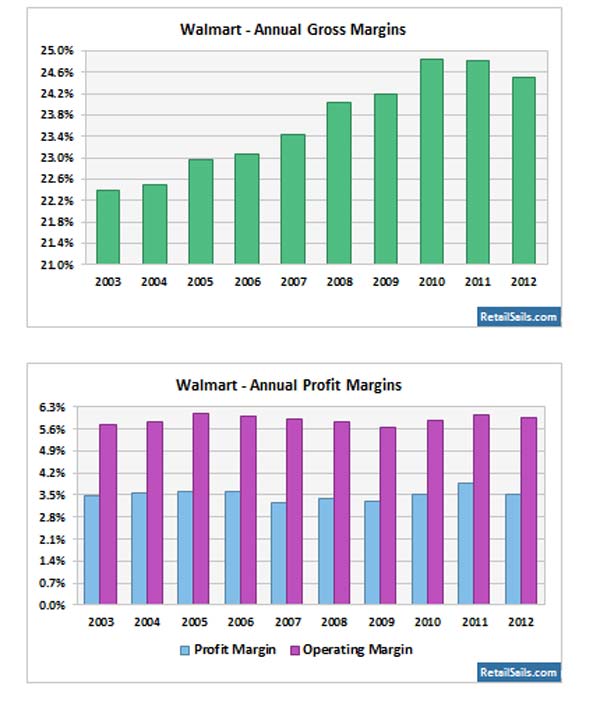
By 2007, executives at Walmart were able to reduce their inventory levels and thereby improve the bottom line. As seen in the below graphic, Walmart annual gross margin improved dramatically after 2007.

Later in 2010, Walmart replaced the barcodes on garments with RFID. The fact that RFIDs can store more information than barcodes which can be used for real time analytics prompted this decision. An additional advantage was that they can be scanned by a distance and without a clear line of sight. This reduced the time to capture the information stored. This reduced lag in information helped the executives at Walmart make informed decisions quicker than before. A detailed explanation of the garment RFID process at Walmart is depicted in the below diagram. It also highlights a few of the privacy concerns with the use of this technology and how Walmart has worked around them.


In addition to Walmart, Harley-Davidson, Toyota and Las Vegas airport (baggage department) have also deployed RFID across their supply chains. Thus, it is reasonable to conclude that fast capture and analysis of supply chain information can generate great business value to organizations across all industries, irrespective of their size. But how large a company needs to be before investing in these technologies is a food for thought.

Sunday, September 29, 2013

Related Article: "The Role of Analytics in the Race for the Supply Chain of the Future"

Week six's articles focused on the role of technology and information in supply chains, with most articles being dated by a few years. Recently, Data Informed published, "The Role of Analytics in the Race for the Supply Chain of the Future", which talks about how behind some companies still are in the fields of technology and information. It also presents information about what happened when they asked over a hundred supply chain leaders to describe the future of supply chains during the Supply Chain Insights Global Summit, which was held this past September. These insights are unique because they pair technological advancements with innovation, creating smarter and faster solutions.

The author, Lora Cecere, starts the article by stating that two main problems continue to persist: 1) the effective use of data and 2) the understanding of supply chains as a complex system. Cecere states that it is extremely common for companies to still use Excel spreadsheets as their most advanced methodology in their supply chain networks. Additionally, she states that only 11% of companies have the capabilities to evaluate a "what if" analysis and only 24% of companies are able to model profitability impacts on changing conditions in their complex systems.

At the Supply Chain Insights Global Summit, supply chain managers discussed what their futures looked like. Logitech had been facing complex issues with their Ultimate Ear product, which is custom built based on a customer's ear canal images. With the advent of 3-D printing, devices can now be made locally, creating a shorter lead time and a lower cost. Another idea that was discussed was the process of fitting knee implants to customers. Currently, the implants are given to a salesperson in multiple sizes. The salesperson shows up at the hospital to do a fitting, and then orders the correct sizes and has them shipped before the surgery. However, supply chain leaders believe that analytics can change all this by redesigning the supply chain. The supply chain could include digital images of the patient's bone structure being sent to a local lab where the replacements are built. Cecere believed that after these innovative supply chains are built, they could be paired with data mining techniques to lessen supplier's risks.

In her article, Cecere never fully answers the issue of so many companies being behind in their use of analytics and technology, which makes me wonder, what will it take for these companies to perform at a higher technological and statistical level? Is it cheaper access to technology and supply chain software, as we can assume that many business are just too small to invest in such things? And if it is cheaper software and technology, what is being sacrificed for the price?

Source: http://data-informed.com/role-analytics-race-supply-chain-future/


he understanding of the supply chain as a complex system and the effective use of data. - See more at: http://data-informed.com/role-analytics-race-supply-chain-future/#sthash.R1uSDfh2.dpuf
Supply Chain Insights Global Summit in September
- See more at: http://data-informed.com/role-analytics-race-supply-chain-future/#sthash.R1uSDfh2.dpuf