Showing posts with label Apple's Supply Chain. Show all posts

Thursday, February 2, 2012

How Should We Face the Phenomenon of “Double Standard” in Global SCM?


– A Second Thought on Apple’s 2012 Supplier Progress Report

In this week’s article, “Outcome Driven Supply Chains”, we discussed six supply chain outcomes that a successful supply chain manager need to take into consideration. They are: “Cost, Innovation, Sustainability, Responsiveness, Security, and Resilience”. The issue of sustainability caught my eye and reminded me some related problems in those global popular manufacture origins. For instance, maintaining sustainable development is always a hot slogan in China; however, the actually implementation is still taking a slow step.

Later in the weekend, I read a piece of recently released news about Apple’s 2012 Supplier Progress Report. It is said that Apple had conducted an internal audit on working conditions within all its alignments on how well its contractors were treating workers that making iPhones and iPads. Below is a chart showing the percentages of suppliers which passed or failed the audits across a number of labor related standards. (You could find this news by:

Source: Apple Supplier Progress Report 2012

Despite the justice and reliability for the results of this reports, or the uncertain scope of sampling population, the passing rate of 74% shows that Apple along with its parterres seems to maintain a good job. Also in this report, Apple claims that it is committed to driving the highest standards for social responsibility throughout their supply base, and it requires all its suppliers to “provide safe working conditions, treat workers with dignity and respect, and use environmentally responsible manufacturing processes wherever Apple products are made."

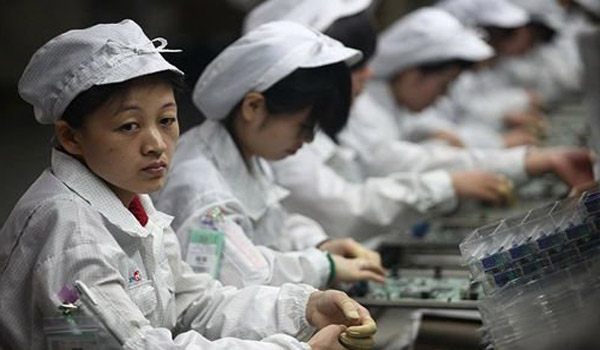
However, in practice, Apple still need to spend more effort to improve their Labor right (especially its working conditions) as well as their sustainability strategies in the developing countries like China, given the bad news in recent years. For example, Chinese environmental groups accused Apple Inc of turning a blind eye as its suppliers pollute the country in 2011. Not mention the famous worker suicides in 2010 that put Apple’s name at risk – as many as 18 employers killed themselves at an Apple assembly plant in China run by contract manufacturing giant Foxconn, leading people to question about how employees were being treated there.

As we all know, many of the world’s famous manufactures are distributing their plants and networks in different countries and multiple cities. Building manufacture centers and assembling plants in developing counties like China, Vietnam and Korea is a common practice in supply chain management. It is a good strategy to take the advantage of the cheap and massive labor productivity, large land, benefit policies for foreign companies and even sometimes, the weak guidance and non-strict laws.

Standing at the management side, it is true that as the plants spread all over the world and different parties involved, a company will find it harder and harder to guard and maintain its high standards and rules. For one thing, you can’t monitor what happens on the other side of the world. While on the other hand, it would be better to let the domestic management group keep an eye and make strategies considering the differences in culture and market needs.

However, should that be a strong excuse for a global manufacturer to have double standards? How should the supply chain manager balance the three A’s (Agility, Adaptability, and Alignment) principles? What strong measures could be used to avoid such messy problems both internal and external? Certainly, a research or an internal audit report is a good start, but far from enough.

Can you think of any successful examples or excellent strategies in existing companies? As the supply chain management is shifting to cross-enterprise in a global scope, I really hope we could discuss some good solutions and practical tactics in class.


Reference for news of Apple:

For the full version of Apple Supplier Progress Report 2012, please follow:


The two sides of Apple’s Supply Chain


The two sides of Apple’s supply chain
Late last year I came across an article with the title “Apple's Supply-Chain Secret? Hoard Lasers”1. The article discussed who Apple gains competitive advantage through its supply chain. It gave a particular example of how when design required light to shine through the metal casing of laptop without making holes in the casing which could be done with the help of  modified laser equipment used in microchip manufacturing, Apple signed exclusive agreement with the laser manufacture and bought hundreds of such laser. With over $80 billion in cash reserves Apple can spend exuberantly whenever necessary, investing in long term capacity commitment and then reaping the benefits from greater volumes in the long run. With Apples approach of looking further ahead in time for its resources, capacity and transport needs it has been able deliver its products to millions of customers across the world with little delays.
Close to product launch dates Apple’s manufactures a kept busy producing the millions of units of the product that is expected to be sold across the world.  Even in the retail store the demand is monitored by the hours and changes made in the supply chain as necessary. In the latest quarterly report Apple stated that it shipped 37 million iPhones and 15.4 million iPads with an average volume of 402 thousand iPhones and 165 thousand iPads per day2.
Apple’s large product launches can severely impact competitors supply chains, such as in the case of iPhone 4 launch when manufactures such as HTC were facing shortages of LCD screens, and glass for the touch screens of their mobiles since Apply had already made large orders for the suppliers to fill.
With such efficiency in procurement, manufacturing, and delivery it no wonder Apple’s supply chain has been ranked No. 1 in the world for the last three years by Gartner3.

Behind this efficient and streamlined supply chain that is presented to the world is a much darker side of Apple’s supply chain, a side which until recently got little exposure. To gain the competitive advantage it has through its supply chain Apple has been known to be ruthless with its suppliers, striving to get the most out of them at the lowest cost and shortest time. Some suppliers are so dependent on the Apple’s business that they forced into agreements which promise minimal returns. To increase their profits suppliers cut corners and use child labourers, inhumane working conditions, low wages, and poor safety standards. Workers often live at the factory in overcrowded dorms, have 60 hour work weeks, and are punished with physical labour and withholding of wages. Reports of worker strikes, suicides, and deaths from factory accidents keep emerging from Apple suppliers such as Foxconn. Apple has to reply on the Chinese manufactures in order to keep the price of their products low enough to be competitive. Moving production facilities to America will significantly increase the price of the products, and put them out of competition against products from companies like HTC, and Samsung.


Apple does have a code of conduct for its supplier but to which extent it is enforced is uncertain. On Apple’s website it mentions that Apple requires suppliers to commit to the principles and standards of their Code of Conduct, and that it has an auditing program in place across their entire supply chain to ensure that the suppliers are upholding to the Code of Conduct.5
As consumer it’s a moral dilemma for us; are we willing to ignore the inhumane conditions of the factory workers as long as we can get our gadgets at affordable prices, or do we take a stand and boycott such products and pay higher prices for products that are produced in factories with better standards.


References