Showing posts with label Logistics. Show all posts

Thursday, February 20, 2014

Logistics in Supply Chain

In the previous weeks of our SCM course we have discussed themes such as customers’ demand and achievement of strategic-fit, products’ design and development, and inventory management. All these topics are related to the subject examined last week: logistics.

This topic is critical for companies, and it drastically influences their supply chain for several reasons. Let’s analyze them focusing on transportation.

First of all, companies’ main goal is to satisfy demand and do it profitably. In order to do that, companies have to meet demand by providing desired products, but they also need to deliver them as quickly as possible, so that customers will appreciate the service and build loyalty towards the company. We may recall the example of the high fashion dress seen on TV on day 0, bought on day 1 and received on day 2. This was possible thanks to an efficient production line, but also to effective logistics.

Second, some companies set up the product design and development phases precisely thinking of how the product will be shipped. For example, [1] Ikea’s designers create all their products in such a way that all the necessary pieces to assemble the object fit in a certain box with pre-specified dimensions. This is because Ikea doesn’t want “to ship air”, maximizing the number of products shipped and limiting the cost of transportation. On the same line of Ikea is [2] Tata with its Nano, the most inexpensive car in the world. Since assembly is outsourced, Tata realized Nano with a modular design and a revolutionary building procedure, so that all its components are shipped and can be efficiently assembled by different entrepreneurs. 

Sometimes, companies prefer to use low cost transportation (on rails or water) and place more frequent orders. This may be done specifically to reduce inventory costs, or also for other reasons, as is the case, for instance, with food products, in order to avoid that they expire.

More and more often companies outsource partially or entirely the management of their supply chain to specialized firms. [3] Brooksint and [4] Essintial are two examples of business firms which externalized several services, such as the management of the inventory or the entire logistics. Sometimes transportation companies themselves propose to take care of different services. This is the example of UPS:  initially UPS was involved in distributing Toshiba’s products and recovering all the products which need assistance. Now, UPS has an own assistance department which is in charge of repairing Toshiba’s products. So, UPS recovers, repairs and brings back to the customers products that must be repaired.

What is the future of logistics? How can technology help in increasing its efficiency? RFID tagging, which allows for better tracking of shipments and assets, is a useful way to manage logistics, but it may raise privacy or security concerns, especially if the transported products are sensitive or particularly valuable. In order to meet customers’ needs at best, companies will need to find a practical, profitable solution to guarantee a timely but at the same time secure shipment. So what’s next for logistics management?


[4] http://essintial.com/field-technical-services/logistics-and-inventory-management/

Monday, February 10, 2014

UPS Supply Chain Logistics- The Direct Method

Every company that manufactures products relies on supply chain networks and logistics. Logistics visionaries have talked for years about eliminating the role of inventory in modern supply chains. The most efficient, slack-free supply chains, after all, wouldn’t require any inventory buffer because supply and demand would be in perfect sync. This vision certainly has its appeal: The death of inventory would mean dramatically reduced logistics costs and simplified fulfillment. The direct-to-store approach is not necessarily the appropriate model for every company, but this technique reduces the inventory drastically. It requires additional coordination further back in the supply chain, including more-accurate demand forecasts and precise delivery allocation planning. And the complexity of managing the process makes it even more necessary to have sophisticated tracking and tracing tools in place to provide detailed supply chain visibility, even as shipments change hands and hop from one mode of transport to another. It also requires a higher level of coordination among functional groups such as inbound and outbound transportation and warehousing.


Direct-to-store offers cost savings in a number of areas:
  •  Capital investment savings: No need to invest in expanding current warehouses or building new ones.
  • Improved network efficiency: Companies can respond to seasonal and peak   demand without having to overbuild distribution capacity that might remain idle during nonpeak times.
  • Reduced inventory-carrying costs: Without the need for warehouse processing and storage, companies can eliminate warehousing and carrying costs, which are estimated to represent about 3.8 percent of sales.
  • Reduced material-handling costs: Direct-to-store can provide significant savings in labor and product-handling costs, both for receiving and outbound shipping.
  • Lower administrative costs: Simpler direct-to-store consolidates management of supply chain functions, so fewer management resources are needed.
  • Lower damage costs: Fewer touch-points and less handling mean less risk of damages to shipments.

Effective transportation management can lower transportation costs, improve inventory management, and enhance customer service and reliability. For innovative companies and products that fit the profile of direct-to-store, skipping the warehouse and keeping inventory in motion can have a direct impact on global business success.

Sources:
  • http://www.ups.com/content/us/en/bussol/browse/supply-chain-optimization.html
  • http://www.ups.com/media/en/wp_inventory_in_motion.pdf
  • http://www.ups-scs.com/transportation/network.html
  • http://highered.mcgraw-hill.com/sites/dl/free/0073525235/940447/jacobs3e_sample_ch11.pdf

Tuesday, February 21, 2012

Logistics: More Than Just Moving Goods

I was reading the article “The Threat of Global Gridlock” about the challenges of transportation in a supply chain, one word kept lingering inside my head: logistics. Probably because it reminded me of a series of TV ads by United Parcel Service Inc., or better known as UPS.

I think I started seeing these ads quite frequently sometime around last year. The company was launching a global ad campaign to promote its expanding logistics business to small and medium-sized businesses that wanted to sell their products globally. They cleverly modified the lyrics of “That’s Amore”, a classic Dean Martin tune, and changed it to “That’s Logistics”. 

I’m pretty sure most of you have seen the ad before, but just in case you want to see it again (or never seen it before), just have a look and enjoy the jingle:

(UPS: We ♥ Logistics Commercial via youtube.com)

In an interview with Ogilvy & Mather Worldwide, Scott Davis, UPS chairman and CEO, said that “People often think of logistics simply as moving goods to the right place at the right time”. That’s exactly how I thought of it.

However, after I finished reading the article, it totally changed my point of view. Scott Davis added that “Logistics can be a powerful tool to help businesses get products to market first, gain operational efficiency, save money and improve customer loyalty.  Especially in today’s economy, companies need an edge and UPS’s mastery of logistics can give it to them.”

For small businesses, going global might sound like a tough order. But thanks to third party logistics companies, it opened up the opportunity for small companies to reach out to the global market. Senior transportation analyst at BB&T Capital Markets, Kevin Sterling said that “Third-party logistics is a growing area at a time of globalization and cost-cutting of in-house supply-chain operations”. He added "If you're a small business, would you know how to ship from China to the U.S., or are you going to hire a team to manage your supply chain?”

However, the recent global recession, the rise of oil prices, transportation congestion, have disrupted the transportation network infrastructure worldwide.

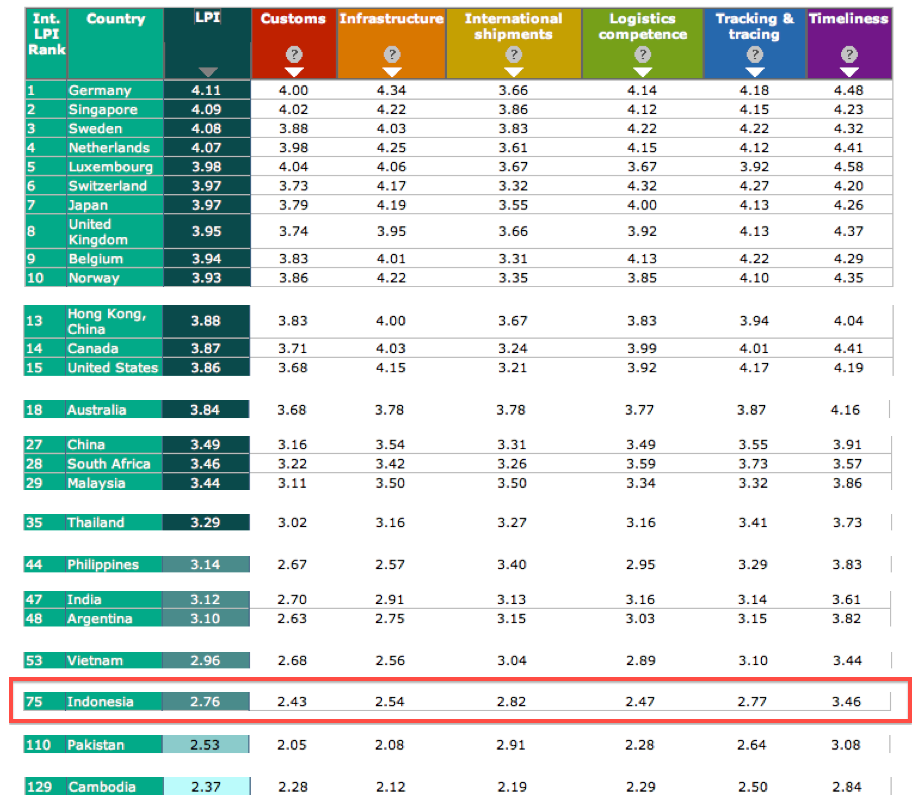
It’s also a significant problem in my home country, Indonesia. In terms of logistics, Indonesia is falling behind its fellow ASEAN countries Singapore, Malaysia, Thailand, Philippines, and Vietnam. According to the 2010 Logistics Performance Index (LPI) released by The World Bank, Indonesia is ranked at 75th out of 150 countries surveyed, the second lowest in the ASEAN region (above Cambodia).

2010 Logistics Performance Index (LPI) ranking - via worldbank.org


Recently, the Indonesian government stated that they are focusing on resolving three major problems that are impeding the country’s economic development. The government have identified that the three major problems are high costs in logistics, dependency on imported raw material for industries, and the issue of labor productivity and waging systems.

Hopefully my government back home will soon find a way to resolve these issues, and in terms of logistics, follow some of the best practices that are mentioned in the article.

Sources:
  1. Stalk Jr., George. “The Threat of Global Gridlock”. Harvard Business Review. July 1, 2009. Prod.#: R0907T-PDF-ENG.
  2. http://online.wsj.com/article/SB10001424052748704621204575487840032479922.html?mod=WSJ_hpp_LEFTWhatsNewsCollection
  3. http://www.youtube.com/watch?v=mRAHa_Po0Kg
  4. http://www.ogilvy.com/News/Press-Releases/September-2010-New-UPS-Campaign.aspx
  5. http://www1.worldbank.org/PREM/LPI/tradesurvey/mode1b.asp#ranking
  6. http://www.bisnis.com/articles/hambatan-industri-hatta-janji-tuntaskan-tiga-masalah-utama


DHL Smart Sensors


Everyone has had the experience of waiting for weeks for a parcel to arrive, and not getting any useful information from the tracking system provided by the courier. We all wish that we could track our packages as they travel from the source to our door steps. The wait is finally over,  DHL has introduced a new service where it allows customers to get real-time information about their package’s location, temperature, humidity, light exposure, pressure, shock and vibration. This is the first service of its kind to have been authorized by the Federal Aviation Administration (FAA) to be used on commercial airlines. The sensors placed in the packages have been specially designed not to interfere with the airplane’s avionics. The device use both GPS and GSM radio to transmit data to DHL’s data centre.  Customers can then access information about their package through an online portal.


Customers can order the sensors to be placed in the packages. This service caters more towards customers that regularly ship urgent and valuable materials. The service has been in demand by pharmaceutical companies that have to ship medicine and antidotes for emergency use.  Hospitals and Organ banks have shown interest in the service to shipping organs.


The Sensors took three years to develop and were manufactured by a third party. During initial trials the sensors were programmed to send status updates every five minutes but that was resulting in the batteries running out too quickly, so the status reports were set to one every hour. This allows the sensors operate two weeks on batteries.

From a supply chain respective this technology gives security and enhanced visibility along the entire supply chain. A client can know in real time where their package is and what condition it is in. 


The link below is a rather humorous video introducing DLS’s Smart Sensor service 


References 

Tuesday, February 7, 2012

Managing Inventory: Learning from Carrefour's Success in Indonesia


One day my wife asked me to buy some milk for my little daughter. Simple task, surely nothing can go wrong. Just go out to a store and buy one.

So I went to a supermarket just a few blocks away from our house only to find that the particular brand of milk I was searching for was out of stock. No big deal, I thought, just find another supermarket. And so I did, I went to a larger one, thinking that they must have the one that I’m looking for. Again, I was disappointed to find out that they were out of stock too.

It was starting to get a bit irritating. For my third and final attempt, I went to an even larger supermarket, or hypermarket these days, located a little further from home. Finally, I got what I was looking for. Mission accomplished.

The name of the hypermarket that had the stock of milk I needed to buy was Carrefour. It is the largest hypermarket chain in Indonesia. We have no Wal Mart, there is no Tesco, K-Mart, or whatever. The French company has been dominating the retail business in Indonesia for the past few years. As shown in the figures below, Carrefour has been expanding its business constantly year after year. Particularly in my country, Indonesia, the number of store network has been growing quite significantly (only second to China).

Store network (consolidated) (source: Carrefour Annual Report 2010)

So how does Carrefour maintain such a business growth as shown in the figures above? Simple, they had the milk that I needed while others didn’t. When people are in need of certain kinds of items, usually Carrefour can provide.

One of the keys to Carrefour’s success in maintaining their inventory of goods is having a well-organized logistics chain. According to Bayu A. Soedjarwo, Carrefour Indonesia’s Senior Manager of Logistics, they had an electronic system that monitored the number of inventory in a store and can automatically send purchase orders to suppliers if certain items run out of stock. In addition to that, he also explained that a supplier only needed to send their goods to a distribution center, where items from all other suppliers will be consolidated to specifically meet the needs (purchase orders) of certain stores.

According to Frederic Fontaine, Carrefour’s Technical Advisor for Supply Chain, this centralized supply chain model is mutually beneficial for Carrefour and their suppliers. For Carrefour, the main advantage is the improvement of stock availability in their stores. This also gives the suppliers an advantage because it eliminates the lost of sales caused by items that are out of stock. Another benefit for the suppliers is the reduction in shipment expenses because they only need to ship their goods to a distribution center instead of going to every store that ordered their goods.

Carrefour's Supply Chain (via carrefour.com)

Sources:
  1. http://swa.co.id/updates/muluskan-distribusi-jutaan-barang
  2. http://www.carrefour.com/docroot/groupe/C4com/Pieces_jointes/RA/2011/Carrefour_Rapport_Financier_2010_72DPI_RVB_GB.pdf
  3. http://www.carrefour.com/docroot/groupe/C4com/Commerce%20responsable/Notre%20engagement%20pour%20l'environnement/Réduire%20nos%20impact%20logistique/infography%20CO2.pdf

Monday, November 28, 2011

Less than Truckload (LTL) Shipping: A Middle Ground

As evidenced this past week in the transportation logistics readings, a supply chain can only be stretched so far. In particular, we learned from the McKinsey Quarterly article and the Harvard Business Review article that at some point, even offshored production fails to be beneficial due to the rising cost of labor and shipping.

When we think of shipping, a couple things come to mind:

The full shipping truck hauling heavy long-distance freight, or

The UPS truck delivering light freight and parcels

It doesn't occur to us, however, that there is any room in between. However, think about it: are there occasions where you'd want to send something over a hundred pounds, but not exactly enough to fill a whole truck? Aren't there business out there that would like to have equipment in the range [90, 16,000] pounds shipped to them from anywhere without incurring the cost of either large parcel post or whole truckload?

That's where Less than Truckload (LTL) technology steps in. LTL is like the baby bear's porridge from the story of Goldilocks: not too hot, not too cold, but just right. It seeks to meet the needs of mid-sized shipping, primarily in the B2B realm.

What is LTL?

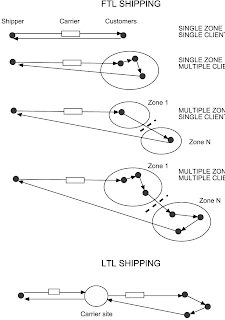
LTL is characterized by the fact that it is a hybrid between full Truck Load (TL) and Parcel delivery services. Instead of delivering a large shipment in bulk or many different, individual parcels, LTL consolidates shipments in single pallets by destination, allowing for delivery to concentrated sites. Typically, the packages are delivered to a central distribution center and then sorted by area/destination. Sound familiar? LTL echoes the lessons learned from the Dabbawallas: other transportation methods can bring the goods to a distribution center so that a truck can pick them up. Hub-and-spoke methodology is critical to the success of LTL.

Great, but does LTL really improve the supply chain?

Although LTL sounds great to a certain segment of consumers, its usefulness has been marred by legislation (and this is the first time in this class that regulatory impact has come up). Under the 1980 Motor Carrier Act and the Trucking Industry Regulatory Reform Act, interstate trucking rates and routes were no longer regulated. According to the Bureau of Transportation Statistics, the result was that collusion between trucking companies became widespread due to the subsequent mergers and acquisitions that occurred (in favor of driving down aggregate costs for the participating firms). Because many of the providers operating LTL services were unionized, it was difficult for consolidated firms to rely on them rather than cheaper TL services, so the importance of LTL was diminished.

This shouldn't get us down though. The need to shorten supply lines and thus the logistics cost per unit of shipping requires SCM practitioners to be vigilant about how they can better organize their shipping behavior. After all, supply chain operating costs are a top concern for CFOs. While larger firms might exclusively use TL for their products due to inventory needs, they would do well to focus on the pallet-grouping behavior that LTL espouses. With forecasting methodology becoming more and more sophisticated as well as the occasional need for responsive inventories (read: Dell), knowing how to group shipments for maximum return on shipment is key to transportation strategy.


Just like how Ikea made sure their inventory was flat so it could fit inside one cargo container, firms would do well to figure out the optimal use of their trucking fleet, whether it is in-house or outsourced.