A collection of resources and commentary providing an introduction to supply chain management and related systems for students, practitioners, and anyone else interested in learning more about how to design, manufacture, transport, store, deliver, and manage products.
Tuesday, February 4, 2014
Walmart: technology and inventory.
Wednesday, January 29, 2014
First, I would like to talk about the Walmart article. It seems to suggest that Walmart got almost everything right in its supply chain: from demand forecasting to ensure that adequate quantities of inventory got to its store locations, to good inventory management practices ensuring timely resupply orders – all operations optimized to laser-like precision. But… in the end it failed to foresee or plan for how its staffers would actually get the merchandize languishing in backrooms to the shelves? Hmm.
Monday, September 9, 2013
Comparing whole foods and Trader Joe’s supply chain
Wednesday, September 4, 2013
Ikea Supply Chain: Sustainability
![]() |
Ikea uses an "e-wheel" to assess the environmental impact of their products by identifying what stage of life the resources for a particular product may be in. For instance, some products require raw materials like wood, while others may be shards of fabric used for rugs, recycled plastics, etc. Additionally, Ikea holds it's suppliers to an environmental code of conduct called "IWAY". IWAY complies with international regulations and implements minimum environmental regulations for all suppliers who work with Ikea.
Internally, Ikea designs it's products to use as little materials as possible. Thus chair legs are often hollow and tables are often filled with a honeycomb texture instead of being completely wood. Additionally, Ikea has created partnerships with several organizations including UNICEF (in an effort to prevent child labor) and the World Wildlife Fund (to promote sustainable forestry and procurement).
In the end, Ikea's supply chain is more sustainable than what meets the eye. Sustainability starts with raw material procurement, supplier standards, internal design, and shipping (as mentioned in the course reading).
Does Ikeas' sustainable supply chain change who their potential customers are? What about its sustainable design, which some consumers may regard as low quality (hollow legs, tables, etc.)? Is Ikea doing enough to promote sustainability as one of it's core concepts to the public?
Case/Article link: http://businesscasestudies.co.uk/ikea/building-a-sustainable-supply-chain/introduction.html#axzz2dw7usjj9
Image taken from http://businesscasestudies.co.uk/ikea/building-a-sustainable-supply-chain/the-primary-sector.html#axzz2dw7usjj9
Monday, September 10, 2012
Survey Article: Supply Chains in Health Care
Friday, February 3, 2012
Green Supply Chain
Feb 3rd 2012
As the public becomes more and more concern about the sustainability of our planet, consumers are asking more and more questions about the products they are purchasing. Despite of the public’s focus on the environment, benefits of reducing a company’s carbon footprint is the least of the concerns of most companies. Most
of them are unaware of the linkage between environmental performance and financial gain. Little do they know, their companies can find cost savings by reducing the environmental impact of their business’ supply chain, from purchasing, planning, and managing the use of materials to shipping and distributing final products. Some companies have already ridden the green supply chain wave to make their contribution in reducing carbon footprint.
In 2008, Burton, world’s leading snowboard company, automated its B2B e-commerce transactions with customers. By doing so, the company not only reduced its paper usage significantly, but also decreased its cost for postage, paper and envelopes.[1] Companies such as General Electric (GE), Toyota Motors, American Airlines cargo, Maersk Line have started using environmental accounting - a process that evaluates the effectiveness of environmental activities from the perspective of cost. In particular, General Electric has a program called "Ecomagination" where they are focused on growing their revenue stream from environmentally friendly products to the tune of 20 billion dollars by 2010. [2] General Motors has also reduced disposal costs by 12 million dollars by establishing a reusable container program with suppliers. Other high profile companies such as Wal-Mart and Apple have also made attempts to reduce the environmental damage caused by not only their companies, but also their suppliers in US and overseas.[3]
Another more recent attempt would be from IKEA, who announced in the beginning of this year to use cardboard pallets to replace for wooden pallets for shipment of their products. A major environmental issue with wooden pallets is that they are vulnerable to insects’ attacks. A wooden pallet needs to be fumigated before it is shipped across national borders, and the chemicals cause ecological
problems when the wood is recycled into paper. Cardboard pallets do not have the same problem. The company has developed a new way to fold cardboard in the manner that would provide the same strength as wooden pallet. Cardboard pallets weights only 10 % weight of the wooden pallet, which will save the company $193 million a year in transportation expenses. The cardboard pallet will be discarded after single use and recycled in the same manner as wrapping paper, protective cardboard corners and such packing material used with IKEA products.[4]
The popular belief has led us thinking that being environmentally friendly will increase expenditure. However, there are lots of companies out there that have proved to us it is possible to improve both financial and environmental performance. So, to all the supply chain executives out there, do not hesitate to think green, because you are out of excuses.
References
[1] "Introduction to the Green Supply Chain." Supply Chain Management.
Web. 03 Feb. 2012.
<http://logistics.about.com/
[2] "Best Practices." Green Supply Chain. Web. 03 Feb. 2012.
<http://greensupplychain.com/
[3] Gupta, Deepak. "Green Supply Chain: Is Going Green a
Cost-conscious Decision?" Management Comes Alive ! Web. 3 Feb. 2012.
<http://www.som.iitb.ac.in/
[4] "IKEA Swaps Wooden Shipping Pallets for Cardboard Ones to save
Money." Ecofriend - Promoting Eco Friendly Lifestyle to save the
Environment. Web. 03 Feb. 2012.
<http://www.ecofriend.com/
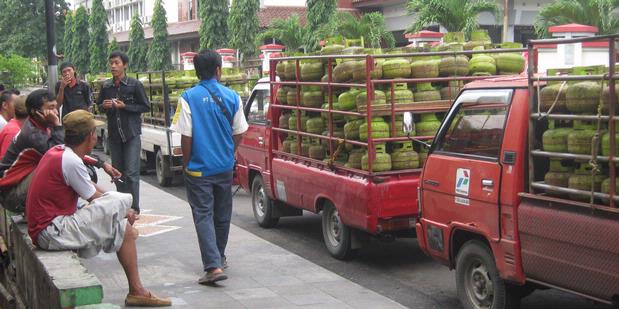
Predicting the Unpredictable: Challenges of Planning Demand and Supply of LPG in Indonesia
These are some of the headlines from local news in Indonesia for the past couple of days:
- LPG (of type 3 kilogram) is Scarce in Majalengka (Friday, February 3, 2012 via seputar-indonesia.com - in Indonesian)
- Supply Interrupted Due To Bad Weather, LPG is Scarce in Lombok (Friday, February 3, 2012 via detiknews.com - in Indonesian)
- LPG (of type 3 kilogram) is Scarce in Kendal (Thursday, February 2, 2012 via kompas.com - in Indonesian)
- LPG is Scarce in Palopo (Wednesday, February 1, 2012 via tempo.co - in Indonesian)
![]() |
| LPG sub-agents queuing at LPG distributor agents in Kendal, Central Java (via kompas.com) |
![]() |
| Kerosene to LPG conversion program (via pertamina.com) |
![]() |
| Two large tankers filling up petrol and LPG at one of Pertamina's depot in Tanjung Uban, Bintan island, the province of Riau islands. Petrol and LPG from this depot are shipped and distributed to the island of Java. (via antarafoto.com) |
- http://www.seputar-indonesia.com/edisicetak/content/view/466195/
- http://us.detiknews.com/read/2012/02/03/153615/1833649/10/pasokan-terganggu-karena-cuaca-buruk-elpiji-langka-di-lombok?utm_source=twitterfeed&utm_medium=twitter&utm_campaign=Feed%3A+detik%2FkgMZ+%28detikNews%29
- http://regional.kompas.com/read/2012/02/02/16421489/Elpiji.3.Kilogram.Langka.di.Kendal
- http://koran.tempo.co/konten/2012/02/01/263245/Elpiji-Langka-di-Palopo
- http://gasdom.pertamina.com/produk_dan_services_elpiji_konversi.aspx
Thursday, December 8, 2011
A Supply Chain Puzzle
The story goes like this: in the late 60s/early 70s, Ford released a new car model. It was fairly well-received, but like any new car model there were some initial 'bugs' that people discovered, and there was one problem in particular that the good people at Ford could not figure out. Dealerships were reporting that exactly one out of every six cars they received from the factory arrived with a dead battery.
Ford's engineers tested the wiring in the cars for faults, but couldn't find anything. They spoke with the battery supplier, and tested incoming batteries to see if one in 6 were faulty, but again: the batteries themselves were fine.
So Ford hired outside consultants and experts who ran tests on the different things... even the interaction of chemicals used in this particular model, but none of the outside people could pinpoint exactly what was wrong. For three months the mathematical equation held: the dealership could expect exactly one of every six cars to arrive with a dead battery.
Finally, a quality control engineer went to the factory that produced this particular car model and walked the entire line, talking to workers at every single stage of assembly. He followed a number of cars all the way to the Final Testing area, and every single car assembled would start up just fine and be driven to the holding lot.
Finally, "He... explained to the tester the situation and asked him if he could think of a reason why one out of six batteries were always dead on this particular model. The guy stared off into the distance. He pondered. He scratched his butt. And then he smiled, and he said he knew EXACTLY what the problem was."
Since we are all supply chain experts at this point, what was the problem? (Hint: This was the old days, when cars were big.)
For the answer, highlight the hidden text below.
[answer]
Here's the answer: As I mentioned, at this time, American cars were BIG. And the trucks that carried the cars could only carry SIX cars. As a result, one of the cars was always at such an angle that the mercury switch for the trunk light (which was the standard at the time) was turning the trunk light on the entire time the car was being was transported, which drained the battery.
[/answer]
So, given what we've learned this semester, what elements of supply chain management were successful in resolving this problem? Ford was able to learn from this mistake, but what lesson could be applied to future problems?
You can listen to the problem here, and the answer here. Or, if you're really adventurous, listen to the whole show here. (note: the answer is not revealed in that show.)
Tuesday, November 29, 2011
3-D Printing Revolutionizes Production Of Quality Assurance Materials In Auto Manufacturing

RapidFit+ (a product of Materialise) has used 3-D printing technology to transform the quality assurance process for manufacturers, enabling the production of previously difficult or even unthinkable designs and making the entire process cheaper, faster and more responsive to design changes.
I believe that this technology has been primarily used in the automotive industry, so far. In these supply chains, smaller manufacturers produce parts that are put into larger parts by other manufacturers, which may be added to even larger components by another manufacturer, and so on until the final components are installed by the automaker in a vehicle. These supply chains can be incredibly complex, and if one manufacturer anywhere on the chain produces parts outside of a very strict set of specifications the whole system quickly falls apart.
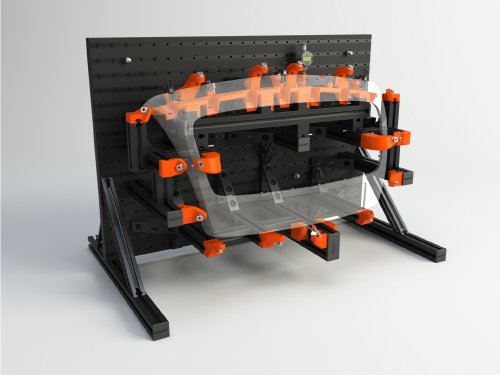
In the past, individually machined (and very expensive) aluminum or steel relief-molds were used by manufacturers to check the accuracy of parts being produced. When a part was produced, it could be slipped into the mold and checked for accuracy. Today, the introduction of new hyper-precise 3D printing technology and the ubiquity of the Internet mean that custom 3D printed objects can be used to verify parts as they move though the manufacturing process.
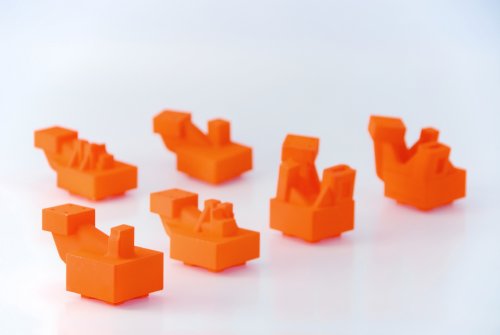
At RapidFit+, an original equipment manufacturer (OEM) can use an online platform to upload 3D and engineering data who then works out a precise rig that can accurately check the dimensions of the finished part within +/- 0.05 mm. At any time the OEM can use the online platform to approve the design or make changes to the parts if necessary. Once approved, a fixture is produced and the precision calibration units are 3-D printed (These are orange things you see in the photo at the top of this post.) and sent to the part manufacturer.
This technology brings numerous advantages to the supply chain. As previously stated, these quality assurance rigs were traditionally made from a solid block of metal. Aside from the huge expense of creating it, these rigs were only accurate for a single part, possibly on a single model of car. With the adoption of 3-D printing, adjustments can be made when small changes are ordered, or for similar parts between different models. Further, these new quality assurance rigs can be produced cheaply, quickly, durably (tests have shown that even after 10,000 cycles wear is limited to only a few microns) and as previously stated the OEM can send design changes in real time. And because the rigs are built on a modular structure, and only the precision "locators" are custom printed, a rig can be configured in multiple ways for multiple parts depending on needs of the part manufacturer.
Currently, RapidFit+ uses this technology in-house, but it is not impossible to see a future where individual part manufacturers invest in 3-D printing technology and their customers are able to upload design specifications directly.
Question: Within the field of supply chain management, for what other applications could 3-D printing technology be suitable?
RapidFit+ using 3D printing to check mass produced parts
Monday, November 28, 2011
Even Without Two Turntables or a Microphone, Reverse Logistics are "Where It's At"

Reverse logistics appears to be all the buzz these days, as many firms look to expand their supply chain beyond the traditional one-way flow that ended when a product got to a consumer's hands.
DIESL, the logistics arm of the Tata Group we discussed in class, has announced it will begin placing a greater focus on reverse logistics across India in order to complement its current supply chain services. The effort is a part of the company's overall commitment to environmental responsibility, and executives expect that this renewed focus will help minimize overall costs for reverse logistics as well as maximizing value from returned items.
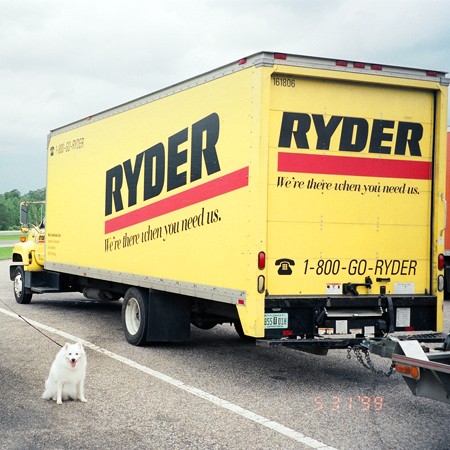
In the United States, Ryder System, Inc. (a name you may recognize from its seemingly omnipresent fleet of moving trucks) recently announced it would be expanding its reverse logistics capabilities to include co-location solutions. According to the announcement: "By co-locating the distribution management of finished goods with returns processes such as technical repair, refurbishment, and repackaging in the same facility, this solution offers companies the ability to achieve greater speed to shelf, visibility, and cost-savings." In plain English, this is actually similar to the Dell technicians (if I remember correctly) who could operate out of FedEx's distribution hubs, as mentioned in class. So the idea is not a new one, but it does appear that Ryder is opening those capabilities up to a much wider range of clients.
Specifically, co-location as a part of reverse logistics can help a company with its sustainability goals, reduce its carbon footprint, save money on fuel costs and reduce total inventory levels through a quicker turnaround of returned product. (This is especially critical in high-tech industries where product life-cycles tend to be short.) The environmental impact of reverse logistics is so pronounced, in fact, that Steve Sensing, Vice President and General Manager of Hi-Tech/Electronics for Ryder Supply Chain Solutions said: "An effective reverse logistics strategy is actually the ultimate recycling process."
Question: do you find the environmental or financial incentives from developing an effective reverse logistics program to be more compelling? Why?
The Reverse Logistics Association
Wednesday, November 9, 2011
If You Don't Want to Get Hit by the Bullwhip, Examine Your Forecasting Technique
In supply chain management circles, "Inventory" continues to be the single issue driving discussions among managers around the water cooler. In fact, "Inventory Management and Planning" was listed as the #1 concern for senior decision makers, as reported by Crimson & Co.'s list of top supply chain concerns for 2011.On this topic, one of the ideas discussed in class this week was the bullwhip effect, and Supply Chain Managers have been looking for ways to manage their inventory in a way that can minimize its impact on inventory levels throughout the supply chain. The consequences of the effect can be severe. It results in each level of the supply chain retaining additional safety stocks in order to be prepared for anticipated demand. This can also lead to inefficient production and/or excessive inventory. And if a supplier fails to meet production quotas, this can also result in contractual penalties.
The effect can be minimized in a supply chain if there is a good system of information sharing among the members, which translates to coordinated action. To further minimize the bullwhip effect, supply chain managers have sought to reduce uncertainty, variability, and lead time in placing orders. (While these sort of strategies can all have broad effects on reducing inventory cost, a paper published in the International Journal of Information Technology & Decision Making argues that it is more variability in lead time, rather than mean lead time, that affects inventory policy and total supply chain cost.)
One way to demonstrate the bullwhip effect is a simulation generally called the "beer game". (For fun, play the beer game here!) This simulation, which takes the form of a simplified beer supply chain, consists of a single retailer, a single wholesaler who supplies the retailer, a single distributor who supplies the wholesaler, and a single factory with unlimited raw materials that brews beer and supplies the distributor. To further simplify things, each component in the supply chain has unlimited storage capacity, and there is a fixed supply lead time and order delay time between each component.
Some new research has taken inspiration from this simple game and created a series of much more complicated simulations in order to try and explain which factors affect the magnitude of the bullwhip effect the most. "Supply Chain Networks With Multiple Retailers: A Test of the Emerging Theory on Inventories, Stockouts, and Bullwhips" (.pdf) published in the Journal of Business Logistics, shows:
"that particular supply chain networks have an impact on the bullwhip effect. Furthermore, the impact of supply chain networks on the bullwhip effect is moderated by the demand forecasting technique used. Finally, supply chain networks, forecasting techniques, and their interactions are found to influence on-hand inventory levels and stockout rates for firms within the supply chain. Results also suggest that no one particular type of supply chain network dominates in terms of dampening the bullwhip effect, lowering on-hand inventory levels, or reducing stockout rates. The optimal network depends on the forecasting technique used and other supply chain factors."What I found most interesting in the article's conclusion was that eliminating forecasting eliminated a bullwhip effect in the supply chain. I also noted that the article concludes that, "when a proper forecasting technique is used, adding retailers to a supply chain does not mitigate the bullwhip effect; however, when using last-period forecasting, adding retailers helps to alleviate the bullwhip effect."
Questions for Discussion:
Based on our class discussions of the Bullwhip Effect, were any of the conclusions of this last article surprising to you?
Further, if you did play the Beer Game, did you see evidence of the bullwhip effect in your simulation? (I will admit: I did, and I was not only aware of the bullwhip effect but consciously trying to avoid it)
Finally, based on what we know about this subject, what is your intuition as to the most effective way to mitigate a bullwhip effect as a supply chain becomes increasingly complex?