Thursday, November 17, 2011

Lean in Software Development


Lean, being primarily a manufacturing and production buzzword has seen its embracement in other industries as well like health care services, food chains etc. I have had a chance to implement and practice Lean in a software development life cycle while working at IBM and I would like to share my experience in this post.

When my team transitioned from a traditional iterative model of software development to Agile model, we decided to incorporate some Lean practices into our development process. The first and foremost challenge in front of our team was to deliver small chunks of code as early as possible to the stakeholders/customers and get an early feedback on the system. Such a change required reducing the development cycle from 6 months to 4 weeks (which was met with a lot of criticism at the onset). But the objective was that the sooner the end product is delivered without considerable defect, the sooner feedback can be received, and incorporated into the next iteration. The shorter the iterations, the better the learning and communication within the team. Speed assures the fulfilling of the customer's present needs and not what they required yesterday. This gives them the opportunity to delay making up their minds about what they really require until they gain better knowledge. Customers value rapid delivery of a quality product.
The Just-in-Time ideology was put into application here , which affected not just the development cycles but the QA cycles as well, the testers had to be ready with all guns blazing the moment a piece of code was available for testing so that defects can be raised at an early stage and fixed appropriately. A significant amount of planning was required at the end of every iteration by dividing the tasks for achieving the needed result.
The Lean paradigm in software development also facilitated the ideology of self-driven teams. A very effective tool that drives this ideology is a stand-up 15 minute meeting every day, better known as Scrum meeting.(the term Scrum is derived from Rugby).


Such a meeting involved a Scrum-master, who is a facilitator of the meeting and all the team members who were required to give answers to three questions in less than a minute
1)       What did I do yesterday?
2)       What am I going to do today?
3)       What is it that blocks my progress?
The idea is to ensure that every team member knows what every other team member is doing so that they can help each other and achieve their targets. Such meetings facilitate transparency and improve communication between team members.  

In terms of reducing wastage in the software development life cycle, Lean facilitates a prompt and responsive testing cycle that goes in hand with the development cycle, which does not allow accumulation of technical debt and aims at providing error-free code at the end of every iteration.

The embracement of Lean practices in the software world is still at an infant stage and needs to evolve as teams are become cross-geographic in nature which adds to the communication overhead between teams. Shorter iterations lead to a stressful time for developers and testers who need to put in and test a lot of features in a very short period of time. Also , getting a continuous constructive feedback from customers about the system is a big challenge , customers are generally not very responsive that too at such frequent intervals.
These are certain challenges faced by the software industry and how well the software industry embraces Lean in the future is something to look out for.

Toy Story Paradox: Future of Inventory Management Software and Techniques

We are surrounded by inventory. The chair we sit on, the laptop we type on or the fancy 200$ jacket we are wearing; everything constitutes inventory. Just imagine, what if your inventory had a mind of its own? Well, that would make our life more challenging as “inventory management” is no child’s play. And that is exactly the reality that “Toy Story” movies portray.

In Toy Story 2, think about the entire inventory at Al’s Toy Barn and the airport that was either damaged or lost because of a few toys’ actions:

· A Buzz Lightyear doll leaves his display and an Emperor Zurg doll breaks out of his box.
· Mr. Potato Head crashes a toy car into several objects while traveling through the store.
· A huge container of bouncy balls tips over, causing a big mess and making it difficult to recover all of them.
· Buzz knocks over a display of board games and action figures, possibly damaging them.
What a mess! People are constantly losing toys in these movies, not because they misplaced them, but because the toys moved.
All managers must heave a sigh of relief that this does not happen in real life and that they have inventory management software that helps them keep a track of the inventory in their store.

Gone are the days, where the store staff ran around the stores with their notepads and pencils keeping a track of which commodity needs stocking on the shelves and when, where and how to order inventory. Inventory management software does all this and more at the click of a mouse.

Companies have to constantly adjust their inventory levels to stay competitive in today’s demanding market. Great inventory management software provides them with that cutting edge by imparting knowledge, speed and accuracy. The software empowers the business by keeping business owners up to date on all aspects of their inventory right from consumer demand to order placement to shipping. Inventory management is important for all business segments. Microsoft caters to all the segments and provides Point of Sale (POS) solutions for small and medium business helping them manage their inventory. The video link below gives a summary of that

http://www.youtube.com/watch?v=7uAbFnKNtiU

In addition, inventory management software can increase the speed of filling orders and cycling through large inventories. Employees can easily reorder items before they start to run out and start filling purchase orders the minute they come in with a few barcode scans.

However, with the advent of QR code, there finally seems to be a platform through which inventory management and marketing could happen using a unified technology. The QR code is capable of handling all types of data, such as numeric and alphabetic characters, Kanji, Kana, Hiragana, symbols, binary, and control codes. Up to 7,089 characters can be encoded in one symbol which is way more than the 20 digits that a barcode can handle. The QR codes embody all the benefits of barcodes and in addition to it are smaller in size, dirt resistant, tamper proof and readable in any direction in 360°.

Companies have already started using QR codes for marketing by employing them on their products while continuing to use barcodes for inventory management.

Do you think that QR codes could be used in the future for inventory management as well as marketing?

Would smart inventory management software be designed that can help manage inventory and also do analysis on which markets result in more revenue based on how many customers used the QR code to get product information and then gone on to buy the product?

Only time will tell!!

Importance of Inventory Management in Supply Chain

Efficient management of Inventory has played a vital role in deciding a firm’s ability to operate with good profit margins. High Inventory Turnover ratio indicates that a company is efficient in managing its inventories and is having high sales. Having no prior knowledge of financial concepts or relevant industry experience, I was forced to think that if the Sales factor in the equation was not in our control, having less inventory would be the way to achieve high Inventory Turnover ratio. The reality however is different. Having low inventory might often result in company not being able to meet the committed service levels, which obviously means that more often than not, customers will be sent back home without the product they wanted or would be directed to other stores. This situation stresses the importance of efficient inventory management and its significance in efficiently managing your supply chain.

While Inventory was regarded as an asset, the Japanese changed the way inventory was perceived by the introduction of concepts like “Just in Time” and considered inventory as a necessary “evil”. The key to the just in time methodology are factors like inventory being closely managed, understanding the customers buying behaviors, having reliable suppliers and removing unnecessary inspection steps. Concepts such as these have changed the way companies perceive the idea of inventory management. Firms now believe that excessive cash tied up in unwanted inventory can be utilized in other avenues that would generate profits. Many companies have been successful in achieving this through improvement of flow of materials in their supply chain. These companies in addition to focusing on the efficient ways to do things, also focused on the strict “don’ts” such as purchasing huge stock and treating them as an asset, excessive changes to schedules, treating all types of stock in the same way without any regard to the value of the good.

“With the new reengineering in management and companies not just adopting just-in-time inventory practices but engaging in more integrated supply chain management, attention has recently been more focused on creating processes that reduce or eliminate inventories, mainly by reducing or eliminating uncertainties that make them necessary. These efforts have been motivated in part by the recognition that metrics describing the performance of a company's inventory management practices can be important signals to shareholders regarding the efficiency of the company's operations and hence its profitability”2

The idea of an integrated inventory management has helped companies through Optimization and Coordination. The integrated system allows companies to optimize the linkage between supply chain and inventory and coordinate the inventory management to reduce costs and enhance differentiation. The maintenance of lower transaction costs and optimum inventory control management is not without some costs and tradeoff. “Past experiences have shown that managing inventory effectively in our economy and the business environment is often difficult. For example, in 1993, Dell Computer's stock plunged after the company predicted a loss. Dell acknowledged that the company was sharply off in its forecast of demand, resulting in inventory write-downs. Also, in 1993, Liz Claiborne experiences an unexpected earnings decline as a consequence of higher-than-anticipated excess inventories. And in 1994, IBM struggled with shortages in the ThinkPad line due to ineffective inventory management (Simchi-Levi et al., 2000). In recognition of these difficulties and the urgency to pursue effective integrated supply chain management, Barsky and Ellinger (2001) pointed out that to generate lower levels of inventory and fewer stock-outs for customers, suppliers and manufacturers may have to hold significantly more inventory and expend considerably more staff time to administer the program effectively”2.

Some thoughts and questions that come across with respect to inventory management are how do companies decide the inventory levels, relevance to the current demand, how forecasting is done efficiently to avoid loss due to improper inventory management, and how much reliance can be on transport and how transit times impact the inventory planning and management.

Credits

1. Logistics and Resource Efficiency – MX Start

2. Role of supply chain management decisions in effective inventory control. - Julius A. Alade, Dinesh K. Sharma, Hari P. Sharma

3. INVENTORY-Critical Issue in Supply Chain Management – by THOMAS CRAIG

Apple tops the list "The Gartner Supply Chain Top 25 for 2011"

Gartner, an information technology research and advisory firm recently published rankings on leading supply chain companies of the world. These leading companies have always been raising awareness of supply chain and its impact on business. The article also talks about the metrics used by Gartner, Supply chain methodologies, Measuring Demand-Driven Excellence, Operational Excellence and Innovation Excellence

http://www.gartner.com/DisplayDocument?doc_cd=213740

Lean Operations Management: Push or Pull?

When we saw the Boeing system in action, it was evident to us that the rate at which the incomplete airplanes traveled on the assembly floor was entirely dictated by the demand for aircraft from the consumers (i.e. an airline company would form a contract with Boeing to produce a certain number of airplanes in a certain amount of time). What if, however, production is NOT dictated by demand? What if production is driven by the amount of input/raw material available for production?

I dug up my old operations management textbook to learn more about lean processes. In this book, they have a section on lean operations modeling that directly describes the differences between push and demand pull.


Under demand push, production is based on several assumptions:

Information about process times, inventory, and product specifications must be accurate
Forecasts of finished goods must be correct
No variability in processing times

Sounds like a lot of big assumptions doesn't it? It should. Based on what we learned about demand variability (aka the Bullwhip Effect) and forecasting methodology, it shouldn't surprise us that these assumptions are rarely met in the real world.

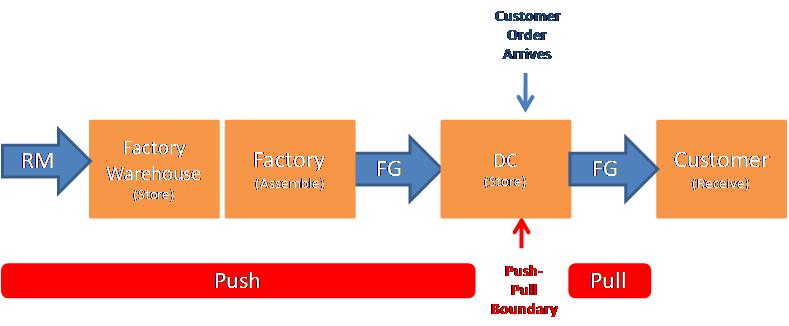
The alternative is demand pull. Pull stipulates that when a customer orders something, each station in the production process reacts to a "downstream" signal from the buyer.

There are 2 requirements:

Each process must have a well-defined "customer" (that is, the thing doing the ordering)
Each process must produce only the quantity needed

Here's a site that illustrates the differences:

In a Push scenario, if we have 100 of A and 100 of B, we'd make all of A and then all of B, regardless of demand.

In a Pull scenario, someone would tell us to make 100 of A and then we would wait for further instructions on what to do next. In particular, a lean system relies upon the kanbans to facilitate this interaction--"consumers" send down their specific needs and the "supplier" meets them.

There are obviously different scenarios in which push or pull methodology would be applicable (mostly related to the demand from consumers). However, it behooves us to understand how the demand is structured, and whether or not we meet the assumptions for push and pull. Can you think of industries that fit either methodology?

Lean Manufacturing Finds a Place in Pharma

Since I will be working in the pharmaceutical industry starting next September, I was very interested to see how the pharma industry has used lean manufacturing to stay ahead of the market. Especially in an industry where R&D costs amount to almost the full cost of a product, lean thinking and lean manufacturing are necessary to stay competitive in the pharmaceutical industry. I found an article that outlines how pharmaceutical companies are incorporating lean thinking into both their research and development and their manufacturing to phenomenal results.

First, it's interesting to note that most pharma companies held off on lean manufacturing as long as possible. Since most of the cost of the product was in R&D, many companies felt that they could gain little to nothing from making their manufacturing processes lean. However, that laissez-faire attitude is changing as pressure begins to come from all places in the market. "The industry's need to increase productivity, combined with pressure from the government, is driving companies to turn to lean," says Robert Blaha, president of Human Capital Associates.

At Pfizer, they decided to use lean principles to cut down on waste in research and experiments. They created a process called critical question mapping, a way to map out all the critical questions that will have to be answered to successfully create a product. In addition to mapping, Pfizer views everyone as a scientist looking for answers. No matter of job title, everyone is expected to question everything and provide answers when ever possible. By creating a system that houses all questions and allows people to answer, research and development time is greatly decreased and successes are much more common.

GlaxoSmithKline (my future employer) focuses on lean manufacturing in the factories. After training 6,500 employees in green belt Six Sigma and lean concepts, they have found tons of benefits. One product's manufacturing costs was cut down by 25% and job satisfaction levels skyrocketed when employees could see exactly what they were accomplishing in the standardized work process. In addition, more open and efficient communication now exists between employees and managers. GSK swears by a combination of principles from Six Sigma and lean when redesigning a process.

It's interesting to see lean manufacturing in an industry that originally thought it was unnecessary and a waste of time. But as pharma companies became more and more competitive and cutthroat, they have found that any time saved is invaluable. Pfizer found a way to make their R&D more streamlined, increasing communication of questions and answers and cutting down on time. GSK took a more typical approach, bringing lean and Six Sigma concepts onto factory floors to shave off extra expenses and wasteful steps.

http://www.industryweek.com/articles/pharmaceuticals_lean_prescription_25078.aspx?Page=1&SectionID=1

I wondered, is lean manufacturing applicable in most cases? We read about Factory Efficiency Comes to the Hospital from New York Times this week and I was surprised by the fact that lean thinking can be applied to healthcare as a service, at least for the processes that can be standardized.

Here's a short clip about how lean thinking was implemented in the clinical department at Birmingham Heartlands hospital in U.K.


The standardized process in discussion was the flow of a patient checking in, being consulted with a doctor, and leaving the hospital. Cutting processes that do not add value to patients has dramatically decreased the waiting time.

But, both the article and the clip discussed how some of the staff resisted such changes because they thought that lean thinking was another tool just to cut cost. As Ms. Munn in New York Times article pointed out, "the essence of nursing is much more than a sum of the parts you can observe and write down on a wall full of sticky notes."

I think the key, especially in service-oriented businesses, is to separate standardized processes from flexible ones. The processes such as patient checking in to a hospital or being examined with MRI are fairly standardized. Such processes are the ones that should be magnified under the lean thinking microscope. In fact, a standardized timed procedure will insure the quality of such processes. For processes such as patient consulting a doctor, or nurses educating the parents, lean thinking is probably not applicable.

Wednesday, November 16, 2011

Sebaks! And robots! And hospitals! Oh my!

Rick Sebak. A year an a half ago I had never heard of him. Now, I arguably see him more than I see my mother...granted it's via the television. Well, a few months ago I was watching one of his many shows about Pittsburgh on WQED, and Mr. Sebak did a small feature on a locally-founded company and their innovative product. That company was Automated Health Systems (which has since been purchased by McKesson) and their product was an automated pharmacy, called ROBOT-Rx.

The product page for the ROBOT-Rx proudly claims the system, "automates medication storage, selection, return, restock, and crediting functions for 90 percent or more of a hospital's daily medication volume." I won't restate the specifics of how the system accomplishes this since they are listed on the product page as well as in McKesson case studies and data the company has gathered since the first unit was installed in 1992 in St. Clair Hospital. Rather, I want to point out that by allowing pharmacists and pharmacy technicians to focus on other, less repetitive tasks, the ROBOT-Rx seems to fall in line with the applied lean manufacturing concepts put forth in the "Factory Efficiency Comes to the Hospital" article included in our readings for this week. Although the change introduced by automation is obviously more of a wholesale approach than the nuanced process changes that were the focus of the article.

While the cost savings from labor efficiencies created by ROBOT-Rx are obvious (this hospital reached break-even after one year of use), the system creates other benefits for hospitals that use it. Similar to Starbuck's stance on introducing lean manufacturing concepts in their stores to increase time employees have to interact with customers, Bob Blanchard, Director of Pharmacy for Evergreen Hospital in Kirkland, WA, said the ROBOT-Rx allows the hospital to "use people for more critical tasks." The system also helps hospitals better manage their pharmaceutical inventories. It provides hospitals with real-time data for their inventories and allows them to carry smaller amounts of stock than they would otherwise require.

So do you think the ROBOT-Rx is a good idea or are skeptical of automation and lean manufacturing techniques in a hospital environment, as some critics in the "Factory Efficiency Comes to the Hospital" were? And do you see this as a better, or more humane (as Mark might assert with his post below), way of dealing with the need for a process to be repetitive and highly specified in order to ensure reliability and efficiency?

How much can one guy take?

As I was reading the article "Decoding the DNA of the Toyota Production System" by Steven Spear and H. Kent Bowan, I started to think about the role of robotics in manufacturing. I guess what bothered me about the article was the constraints placed on Toyota's employees who are on the assembly line. There was nothing in the article to say that the workers were mistreated or unhappy in their work, but I can't help but feel that there may be a point in lean manufacturing or assembly line production where you just have to have a robot. Let me explain...

Operators at Toyota plants, in this case a plant in Georgetown, Kentucky, follow a very well-defined sequence of steps when undertaking a specific task. For example, when they install a car seat, they have six steps to follow, with each step controlling for quality. My concern involves the time constraints placed on employees. Let's say, as in the case, that an employee must complete one of the steps in 50 seconds, and if they don't, then management is alerted that something is wrong. At what point does a monotonous task (with a time limit) have a detrimental effect on human psychology and, ultimately, performance?

I understand that adding jobs builds value to the community and economy...but, at what point is a task so lean and specific that it should be carried out by a robot for health and safety concerns? Have any universities or consulting agencies published any studies about the long-term effects of lean labor practices on assembly line workers? Even at the height of Henry Ford's time (when I'm assuming workers' rights were not of the highest priority) production couldn't match the speed and efficiency of today. So, when does a manufacturer have to stop and say, "I'm not just using robots because it's economical, I'm using them because the task is unbearable."?

If management science has taught me one thing, it's that 100% utilization of employees ends in undesirable results. Lean manufacturing, as it seems to me, certainly comes close to 100%.


Tuesday, November 15, 2011

Lean Manufacturing in Low-Volume Businesses


The latest podcast (.mp3) in a series on lean manufacturing by the Rexroth Bosch Group focuses specifically on applying lean manufacturing techniques to the aerospace supply chain.

When most people think of lean manufacturing, they generally think of high-volume industries where the work requires a lot of repetition. In a field such as aerospace, however, the work is by and large customized, and orders for parts can be on the order of the tens or dozens, rather than tens of thousands. In such a low-volume business, often with much smaller-scale suppliers, it isn't immediately apparent that lean manufacturing techniques would necessarily be applicable.

While low-volume industries do require a great deal of customization, on the podcast Richard Rahn speaks about looking for commonalities among parts supplied and between processes. He talks about an assembly process that would more resemble putting together "Legos" than the traditional "job shop". But this type of a change would mean that manufacturers are much more dependent on their suppliers within the supply chain.

Most importantly, he mentions that the idea of lean manufacturing should be thought of, not as a process, but more as a philosophy. With that in mind, even low-volume industries like aerospace can take full advantage of the competitive advantages and cost savings that lean manufacturing provides.

The Lean Podcast Library
Episode 17: Lean Transformation in the Aerospace Supply Chain

Questions: given the source of this podcast and its expert (a company that devises lean marketing products for businesses) do you buy into the proscribed applications for low-volume businesses? If some lean manufacturing techniques can be used in a low-volume business, do you think the effects would be significant, or is it merely a way to affect the margins?