Tuesday, February 25, 2014

Best Value Supply Chains of the 21st Century


An organization of people, activities, resources and information working closely to deliver a product/value to the customer forms the essence of supply chain. Enhancing the efficiency of the supply chain was mostly considered as integrating and coordinating the various elements of the supply chain. But the demands of the 21st century are different. Speed or time is not the only which determines the effectiveness of the supply chain. A best value supply chain rather focuses on providing a complete value addition to the customer. The target dimensions of a best value supply chain are: speed, cost, quality and flexibility. Since customer needs are multi-faceted, best value supply chains are more effective in creating a happier customer.

A Best Value Supply Chain


The best value supply chains differentiate themselves from the rest by the way they approach three key issues closely related to the strategic supply chain management. These issues are agility, adaptability and alignment.

1.    Agility - Agility is the supply chain's relative capacity to act rapidly in response to dramatic changes in supply and demand. Agility can be achieved through the use of buffers. Excess capacity, inventory, and management information systems all provide buffers that allow a best value supply chain to provide better service and be more responsive.
Agility in supply chain can be achieved by co-locating with customers. This arrangement helps in creating a better information flow.

2.   Adaptability – The willingness and capability to reshape supply chains when necessary is adaptability. For example – in the US defense industry, one set of weapons needs repair in 8 hours while the other set can take up to one month. To be able to adapt to these requirements, supply chains need to be adaptable.

3.   Alignment – Creating consistency which best suits the interests of all refers to alignment. Collaborative forecasting, carefully writing incentives to contracts can be helpful in creating alignment. Alignment plays a crucial role when demand is uncertain.


The best value supply chains use strategic supply chain management to coordinate the major supply chain elements. These elements being:

1.      Strategic Sourcing
2.      Logistics Management
3.      Supply Chain Information Systems
4.      Relationship Management

The best value supply chain uses the above elements to create competitive advantage to enhance performance. Through balancing these four metrics best value supply chains attempt to provide the highest level of value added. Firms like Wal-mart, Toyota, Zara have used these techniques to gain a competitive advantage over their peers.

Strategic Sourcing – Sourcing plays an important role in the supply chain as it decides the inflow. For example – John Deere tractors use more than 60% of the external items to develop tractors. The inflow of items form a critical component of the supply chain because it is the starting point of production. Practicing earlier involvement of supplier can help in reduction of cost by 20%. Human resources, measurement systems and strategic sourcing design are the three enablers of the strategic sourcing in forming best value supply chains.

Logistic Management – ­­­­­The ideal balance of speed, quality, cost and flexibility defines the value proposition of logistic management. Best value supply chain differentiates themselves from typical supply chains by integrating logistics in the strategic management. Positioning Inventory and building a flexible chain structure forms the basis of logistic management.

Supply Chain Information Systems – Information Systems aim at linking all the elements of the supply chain seamlessly to track information from the starting of product development to its delivery. However, information systems should make sure not to divulge any firm's sensitive data unless required. Transaction Systems, Management control, Strategic Planning and Decision Analytics form the key components of the Supply Chain Information Systems.

Relationship Management – Integrating participants in the supply chain is crucial to the success of the supply chain. Cooperation and Collaboration are two ways of organizing relations within the supply chain. Cooperation refers to contractual relations which sometimes complex and involve negotiation. Collaboration, however refers to trust based relations.

A Case Study: Many firms in the present are striving to achieve the best value supply chain. However, Raytheon Technical Services Company, LLC is one of those firms moving fast towards best value supply chains. They are providing best value to their customers by following the three A's (Agility, Adaptability and Alignment) and the four key components of the best value supply chains. Raytheon is one of the industries from which US Military outsources supporting functions. 

Raytheon is achieving agility by co-locating near the military offices. Raytheon provides support for live-combat simulations. Thus, it operates management facility very close to the military offices that run the simulation. 

When cell phones and other detonators were used as explosives in Iraq, Raytheon had to adapt quickly to this new change. They created a rapid response supply chain by deploying the best resources available with them. 

Raytheon uses financial incentives to create alignment amongst its members. There are also monetary penalties associated for wrong doings. But to maintain positive energy and cross collaboration, the incentives are much higher than penalties.

To comply with the strategic sourcing, the company uses the strength of big and small firms with the type of material needed. They use mobile repair vehicles to service equipments sticking to the best practices of logistic management. Raytheon has also attempted to make its supply chain better by developing an information system combining the latest developments in the data and the system concepts. They have built a federation of small business to maintain relations with its small business partners. The federation provides the innovative small firms with infrastructure and resources to bring them together to solve complex problems. 

Looking at the future forward, we can say the competition is not going be product-product or firm-firm, but it will supply chain - better supply chains. And this is the point where the firms need to question themselves - How much are they ready to adapt to this change? What are the things they could do better in order to move towards the notions of Best Value Supply Chains?


REFERENCES:
[1] http://www.rtn.com/ourcompany/rtnwcm/groups/rtsc/documents/content/rtn_b_rtsc_wp_1.pdf 
[2] http://en.wikipedia.org/wiki/Raytheon

Cloud manufacturing to disrupt global supply chain networks

We’ve learned just how complex supply chain networks can be, and how important communication between different links in the chain can be. As we continue into an increasingly more global era, these networks are growing exponentially more complex, and expectations from consumers are growing accordingly regarding speed, accuracy, and flexibility. To cope, manufacturers have begun to take advantages of cloud-based SaaS infrastructures that bring together multiple topics of supply chain management under a single umbrella. From demand forecasting to vendor managed inventories, to automated customer service, these cloud-based systems can be deployed extremely quickly as is discussed in the following article from Forbes magazine: http://www.forbes.com/sites/louiscolumbus/2013/05/06/ten-ways-cloud-computing-is-revolutionizing-manufacturing/


Personally, one of the most interesting and most powerful parts of cloud manufacturing comes from efficiencies in decentralized and networked production. Still early in adoption, flexible and vast networks of specialized manufacturers are being created that can be utilized by partners that are connected via the same or communicating cloud manufacturing platforms. These networks are comprised of manufacturers that specialize in certain tasks, such as threading or stamping or molding. When a demand for a certain part increases, the system can scan this network to identify in real-time which manufacturing facilities will be able to take on new orders, and share the entire manufacturing process of the goods between the network of specialized manufacturers, and then find the most efficient route through the network to have the products made as quickly as possible. By sharing the burden across a large network, and specializing their manufacturing, partners can take advantage of economies of scale to make their process extremely efficient, because variances in the process are removed, and all logistics are handled through the same automated cloud platform. Not only that, but the specialization yields extremely high accuracy. Fewer logistical errors, higher throughput, and higher accuracy…it’s no wonder cloud-based manufacturing and distribution software is set to grow 45% within the next 10 years.

Achieving the Internet of Things through 3d printing

The Internet of Things is not a new concept, having been discussed in literature since 1991 and coined by Kevin Ashton in 1999. However, until recently, the concept has been regarded as more futuristic than practical. Technological innovations such as RFID and QR codes have laid the foundation for the digital cataloging of items, in a robust enough manner as to make the concept of on-demand web based inventories feasible, but now a new wave of hardware and software innovations in the field of 3D printing is making the Internet of Things a reality.

3D printing, known to those in the field as additive manufacturing, is becoming ubiquitous in the manufacturing world. The technology is not new, having been used in the field of rapid prototyping for over 25 years. But recent advancements in the field catalyzed by the expiration of a few key patents have thrust 3d printing into the eye of the public as prices are plummeting and the software and hardware for 3d printing has become much more widely available and useable. More and more, 3d printers are being utilized for end good fabrication instead of mere prototyping. And an inherent benefit to the technology is that one-off goods can be made affordably, without requiring the large volumes necessary for traditional manufacturing methods.

Companies like Shapeways are creating avenues for designers to sell their 3d models online, and have these goods manufactured, personalized, and fabricated through the web and shipped directly to customers. An interesting application that is being discussed and will have large effects on global supply chains, is in the midst of being implemented: 3D printing replacement parts for broken or defective components, especially for products that have been retired and are no longer being manufactured. Companies like 3DLT are partnering with content providers and big name manufacturers to license 3d models of existing and outdated components, so that soon instead of returning an entire product for repair, broken parts will be able to be shipped on demand, or even printed out at the point of need. This spells less waste and headaches for supply chain managers and less of a burden on repair teams when defective items can be repaired with a simple fix. With technologies like 3D printing paving the way, experts estimate that around 25-30 billion devices will be wirelessly connected to the Internet of Things by the year 2020.


3D Printing's Impact on Supply Chain

3D printing as the cutting-edge topic in the manufacturing industry, is not only a revolution of manufacture, but also likely to be for the supply chain, which is the supplementary of manufacturing industry. After reading on several materials regarding the impact of 3D printing on supply chain, I will discuss the reason why 3D printing is expected to be popular, as well as some of the concerns of 3D printing usage in manufacture.

3D printing generally reduces the needs of supply chain, because middle products and assembly process are no longer needed. With 3D printing, only raw materials for 3D printer is needed and the printer could print out the whole product. In this sense, the whole supply chain would be reduced no matter offshore or domestic. Also, the storage of middle products would reduce, therefore the many international warehouse would eliminate. The time of transportation would also be decreased, therefore to increase the respond time for a product.

But in a more detailed sense, we can demonstrate how easily during 3D printing era for developed countries to withdraw the manufacturing processes from offshore. Previously, companies in developed countries mainly outsource manufacturing because of low labor cost in countries such as China, the Philippines or Nepal. With the 3D printer, however, the domestic manufacturing cost would be lower than production cost in developing countries plus transportation cost.

However, 3D printer does initiate some concerns. The current technology only allow very few products to be manufactured, mainly plastic ones. To replace the enormous amount of products we have now, 3D printer has a long R&D process to go through. 

Also, if the 3D printer is one day put into mass use, just like robots, will eliminate many working positions such as low-level assembly workers. High unemployment will impact on all countries yet mainly ones with low labor cost. This scenario would be prevented by leaders in those country. We could readily imagine how those countries hope to slower down the development of 3D printing technology.  

To summarize, the development and popularization of 3D print is going to be way ahead in the future due to policy issue and technological restrains, as well as the effect on the supply chain. Although once initiated, the change will be enormous.

References:
http://www.smartplanet.com/blog/bulletin/3d-printing-may-put-global-supply-chains-out-of-business-report/2019
http://cerasis.com/2014/02/10/3d-printing-supply-chain/
http://supplychainmit.com/2013/07/18/does-3d-printing-doom-the-supply-chain/


A Peek at the 21st Century Supply Chain Management System – Challenges and Opportunities

The Present Scenario

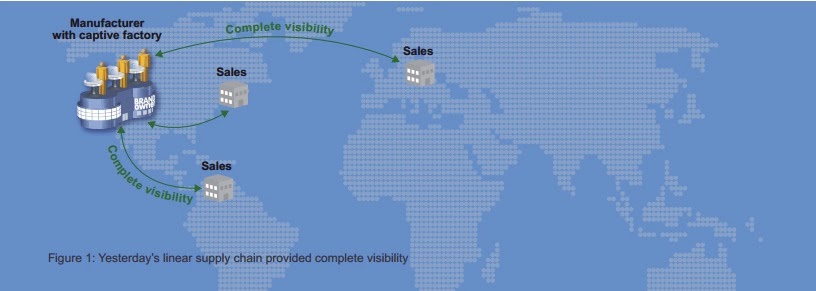
In today’s fast paced world, it is important for Supply chain managers to modernize their supply chain to meet the challenges of the 21st century.  Consider the manufacturing world: Twenty-five years ago, most manufacturers owned their own factories and controlled their own production. They had complete, detailed knowledge of the capacity, schedules, and costs of manufacturing. Companies could adapt quickly to changes in the marketplace and restore the supply/demand balance more easily.

The below figure shows the once-linear relationship companies had with their captive factories and sales offices. In the days before e-commerce, consumer demand fluctuated relatively slowly. With complete visibility into their own factories and sales offices, companies could easily find the status of inventory, work in progress, and customer orders currently in the supply chain.


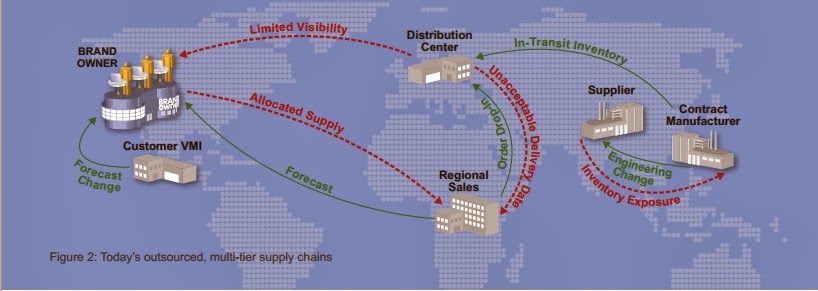
The following diagram shows how today’s supply chains consist of multi-faceted and globally distributed relationships that exist across different time zones, cultures, and technologies. On the left is the brand owner, perhaps a typical consumer electronics firm based on the west coast of the USA. The green arrows show predictable and planned exchanges of information such as forecasts, orders, and engineering changes. The red dotted lines show the unpredictable challenges of today’s market, such as short supply and late deliveries. Many manufacturing firms now have little visibility or control over their supply chain partners. And that means less agility to respond to any changes in supply or demand. With limited visibility into the operations and constraints of third-party partners, it becomes more and more difficult to make decisions or take action on urgent demand spikes or natural disasters.


What Companies Should Look For in the 21st Century

Companies today need technology that provides quick decision support for managers seeking to maintain an effective balance between demand and supply.
In particular, Supply chain Managers should look for three key strategic elements:
1. Agile response. This allows team members to react in a timely manner and move toward event-driven planning.
2. Live collaboration. This creates an online forum where human intelligence can help capture all the nuances of business partner relationships.
      3. Flexible “what-if” testing. This allows decision-makers to weigh the consequences of various decisions       more precisely, with all the information they need at their fingertips. 

In addition to this, firms, especially manufacturing companies should consider incorporating critical features such as web based access, live scorecard, spreadsheets, personal alerts and have an effective response management system. The key here is to Innovate.

My Take on the idea of Innovation and Technology in SCM
It is good to constantly innovate and use cutting edge technologies in supply chain practices.  In complex global supply chains, the balance of innovation and sustainability is a double edged sword. Being sustainable demands creativity in business operations, but innovation also carries the risk of creating unsustainable practices and products. Unproven technological innovation for the wrong reasons can lead to disastrous results. A high profile example is Boeing's continuing nightmare regarding the development and introduction of its 787 Dreamliner aircraft.

Having mentioned that, I think it would be fair to state that companies can distinguish between the steady and step change varieties and understand what it takes to implement them in terms of the organizations strategic objectives, but at the same time not redefine markets. Reconfigure known methods and technologies to improve effectiveness, rather than invent new ones.

The main question of concern to be contemplated here is:
How effectively will companies be willing to adopt technology that would innovate and increase efficiency, but not be disruptive to their existing practices?

References:
http://nbis.org/nbisresources/supply_chain_management/five_secrets_of_the_21st_century_sc.pdf
http://www.theguardian.com/sustainable-business/supply-chain-innovation-double-edged-sword
http://www.supplychain247.com/article/how_many_supply_chain_innovations_are_truly_revolutionary

Is Cloud ERP the ultimate solution to our problems?

Nowadays, Cloud ERP has become a hot topic among manufacturing and supply chain industries. It provides several advantages over traditional ERPs such as low initial cost, flexibility, scalability and the burden of software maintenance is on the vendors. Often the operation cost is also low. However, can we blindly go and support the implementation of cloud ERP? Many of us would say yes but there are some things that you should definitely look at before moving forward with cloud ERP.

You need to identify how important is your business data that resides on your ERP. Many organizations place high importance on data security and hence they are leery of placing their data on cloud ERP. In case of supply chain too, you need to identify how important is the privacy of data that flows through different ERP/ legacy systems. It does not mean that cloud ERPs are not secure. Cloud providers, including Oracle and SAP,have invested heavily in state-of the-art security that may exceed what a hosted solution, or even an on-premises solution, can provide. Some of them are even willing to guarantee that the data will stay in the same national jurisdiction or in a specific data center.

The second issue could be the level of customization that can be provided by the Cloud ERPs. Supply chain consists of an intricate network of various ERP systems that are connected together in a fashion that meets business requirements. These business requirements differ from one organization to another. So, it is practically not possible for any Cloud ERP vendor to design their solution that meets the need of every customer. They design standard ERPs which may be useful to most of their clients but such solutions do not meet all the business requirements.

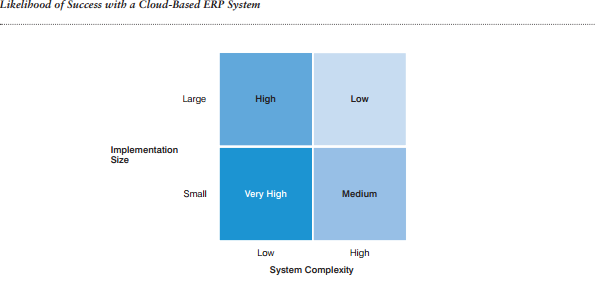
It is essential to know when you should go for cloud ERP and when you should not. If the system complexity and implementation size is small it is often recommended that the organization should implement cloud based ERP system rather than traditional ERP system. On the other hand, if both the system complexity and implementation size are large, you should settle for traditional ERP systems. At first glance, it is not clear why one should follow this approach, but there are certain reasons behind it. Can you think of any?

Source- "ERP in the cloud Is it ready",http://www.booz.com/media/file/BoozCo_ERP-in-the-Cloud.pdf

Supply Chain Networks

 The power of supply chain has been realized by the industry however it did take them a long time to look beyond their product and services. A good understanding and management of the supply chain can provide vital information to the business. It is not only about how a product or raw material is moved from point A to B but it also gives you information about the demand and supply. Today supply chain management is broadly understood as bringing the right product to the right customer at the right time in the right quantity for the right value.

As easy and simple as it may sound; supply chain is not an area that has been mastered. It is dynamic, ever changing and ever evolving. The decisions involve areas as big as inventory management and logistics to as small as how the packaging should be done? Do you use bubble wraps or foam wraps? Let us take an example of transportation of goods; we come across questions such as using in house transportation versus outsourcing the job. And each of these options has various pros and cons to itself. While in house transportation means a stronger hold on the execution of the task, outsourcing means giving the job to a company who is an expert on the subject and could save the company a lot of money. On the other hand, supply chain management also plays a major role in the production front. A business has to optimize the incoming of raw material which of course has a direct impact on costing of production.

This brings us to the topic of supply network; both incoming and outgoing for the business requires a thorough knowledge on the subject. Information ranging from road tax or shipping cost to availability of transportation from source or to destination. It may be a fantastic idea to sell sand duster to islanders but how easy is it to transport your sand duster to the island? What will be the selling cost at the destination? Or should you manufacture your jeans from cotton grown at place A or is it a better idea to manufacture it from the waste produced by the locals. Now if the company does come to the conclusion of either selling the sand duster to the islanders or manufacturing jeans from cotton, a whole new world of logistics opens up. It is here that the company decided on the actual supply chain network. A company may opt for one mode of transportation or a mix of it. The sand duster could be moved from point A to B by road and then from B to C by either air or sea. Or it could be moved from A to C by air. And it is all these decisions that lead to strategies that make or break the business.

Supply chain, like many other business strategies, is also not one that can be decided upon once and be forgotten about. It has come to a point that business are hiring supply chain specialist to give them a competitive edge.

References
http://www.thesupplychainnetwork.com/

What is ERP? How has it improved efficiency of small businesses?

There are a growing number of software suites that can help companies maximize efficiencies in their supply chain. There are specific software packages that can be implemented for purchasing or planning, but there is a software product, called Enterprise resource planning, that can be implemented across the company incorporating all aspects of the enterprise.

Enterprise resource planning (ERP) is business process management software that allows an organization to use a system of integrated applications to manage the business and automate back office functions. ERP software integrates all facets of an operation, including product planning, development, manufacturing processes, sales and marketing. Enterprise resource planning (ERP) software has been implemented by a large number of Fortune 500 companies in the last twenty years. The common database and real-time processing has allowed companies to benefit from reacting to situations in the supply chain that would not have been possible without ERP software. The basic goal is to provide one central repository for all information that is shared by all the various ERP facets in order to smooth the flow of data across the organization.

A business can use ERP software to manage back-office activities and tasks including the following: Distribution process management, supply chain management, services knowledge base, configure, prices, improve accuracy of financial data, facilitate better project planning, automate employee life-cycle, standardize critical business procedures, reduce redundant tasks, assess business needs, accounting and financial applications, lower purchasing costs, manage human resources and payroll. As the ERP methodology has become more popular, software applications have emerged to help business managers implement ERP into other business activities and may also incorporate modules for CRM and present them as a single unified package. CRM is the abbreviation for customer relationship management. It entails all aspects of interaction that a company has with its customer, whether it is sales or service-related. Depending on your organization's size and needs there are a number of enterprise resource planning software vendors to choose from. Three companies dominate the ERP market for large enterprises: SAP, Oracle and Microsoft. 

Chobani Yogurt Company has experienced tremendous success, growing from five people in upstate New York to a global organization of more than 2,200 employees in fewer than 10 years. As a start-up, the company had limited IT resources, but as growth accelerated the company turned to Microsoft Dynamics for help managing change. It uses Microsoft Dynamics CRM to manage its relationships, whether business-to-business, business-to-consumer, or even business-to-employee. The real-time availability of data across these systems has enabled the rapidly evolving company to collaborate across organizational boundaries; in addition to geographic boundaries, ensuring that everyone remains in touch with the principles on which Chobani was founded.

One question that comes to my mind while reading these articles is how crucial is this data across the ERP systems for the successful running of the companies? I am curious to know more how does ERP increase the profitability or the turn over rate of the companies?

Sources:
http://logistics.about.com/od/supplychainsoftware/a/SAP.htm
http://www.microsoft.com/en-us/dynamics/customer-success-stories-detail.aspx?casestudyid=710000002204
http://www.webopedia.com/TERM/E/ERP.html
http://www.webopedia.com/TERM/C/CRM.html


The Future of Supply Chain

       As technology and complexity in supply chain management grows in the coming years, several methods and technology has evolved to force the status quo to adapt and change.
  1. 3D printing- this technology, although still in the early stages has proven to be an integral part of the the future. Reports have estimated that as much as up to 80% of finished goods produced will use 3D printing. This could change the way manufacturing is viewed, as large scale companies could shift more of the workload from globally to locally.
  2. Social Media- the widespread use of social media in society has allow customers and suppliers a level of transparency that was never there before. However, most people in SCM are still hesitant about the technology due to fear of increased scrutiny. This does not have to be the case, as those who are visionaries can see that this technology will allow better communication and allow for real time issues to be addressed between consumers and suppliers.
3. Increased globalization- this is a challenge that all SCM are dealing with. As the world becomes more integrated, it is imperative that managers and organizations must figure out a way to manage the enormous complexity of the supply chain. Technologies such as social media and cloud computing can help with this challenge. To survive supply chain entities must incorporate management tools and techniques that will increase and support efficiency across the supply chain.
4. Cloud computing- as mentioned before with the growing complexity of the global supply chain, it is imperative that supply chain managers are able to make critical decisions quickly. Cloud computing is a solution to this. With this technology businesses will have at their hands data and the ability to access such data anytime and anywhere.
5. Multi-echelon approach- technology is vital to a supply chain, but just as important is maximizing efficiency of inventory. A multi-echelon approach employs a bird's eye view of the entire inventory and try to optimize the efficiency of the whole network rather than just a single warehouse. This method will allow safety stock to be placed in optimal locations and free up cash for businesses to re-invest in themselves.

Question: What challenges will businesses have in trying to employ any of these methods into their organizations?

Source: http://www.supplychaindigital.com/outsourcing/the-future-of-the-supply-chain