In an increasingly digitized retail marketplace, consumers have access to much more information, and supply chains have to act in accordance with consumer expectations to stay ahead of competitors. The growth of the internet has spawned a large online marketplace for consumers to quickly and directly order products. Online retailers are growing in number of outlets and products sold, and their business operations have to be able to support these orders. The supply chains have to support the retailers in such a way that they can deliver large volumes of products within a short time frame.
The age of the internet in online retail has also given consumers more of an easy opportunity to compare prices and shop around between different retailers. They are easily able to research a product, find price and shipping delivery and cost variations, and choose their vendor according to what best fits their immediate needs. Never before has a price-sensitive consumer been able to so easily choose between different sources of products.
Price sensitive consumers should be a huge focus of online retailers. People who shop online tend to do so because prices online are generally cheaper than in a physical store. For instance, electronics are for the most part available for a lower cost through Amazon rather than a retailer like Best Buy. Since retailers' operating margins depend heavily on selling in quantity, offering a product at a lower cost could mean the difference of thousands of dollars on a larger scale operation. Retailers, both online and physical, need to therefore appeal to the price-sensitive consumer in order to sell the volumes needed for mass profit. To offer products for a lower price, the cost of operations, especially shipping and distribution, needs to be minimal.
Retailers can achieve this through closer proximity of distribution centers. By keeping distribution centers closer together, shipping costs can be minimized. The time it takes to get the products to consumers is also going to be severely shortened. Closer distance of hubs will give consumers an incentive to use a specific retailer because they will be able to offer a lower price and a shorter time to receive their orders.
Online ordering for consumers also enables them access to customization. For instance, when ordering a new Dell computer, customization options are given on a widespread scale, to a point where very few customized systems are alike. This forces the retailer to keep very good stock of inventory. Just as consumers are becoming more technology-based, so too are retailers. They have to have the capability of keeping stock of inventory, tracking orders, and making sure customized orders are being put together as specified by the customer. Retailers are upgrading their computer systems to optimize locations and inventory parts, track customized orders, and make sure that the final product meets consumer expectations. Supply chain computer systems have never made it easier for suppliers to track customer orders and give consumers their products in a short amount of time.
Questions for further consideration:
How do consumer expectations influence what retailers they choose?
What role does social media play in perceptions of consumer retailer choices?
How does a "price-matching" strategy for physical stores affect supply and demand in their supply chains?
What is the best way for a supply chain to plan for growth?
Should consumers have transparency for inventory management systems?
Works consulted:
http://www.arabiansupplychain.com/article-10429-is-the-digital-boom-driving-supply-chain-changes/
Monday, September 29, 2014

Mass Customization - The Future of Retail
In any market, “Customer is the King”. Hence, it becomes
imperative to provide outstanding service to customers. Flexible work flows and
latest information technology allow companies to customize their products and
meet their customers’ unique needs at a low cost. Mass customization is
described as "enabling a customer to decide the exact specification of a
product or service, and have that product or service supplied to them at a
price close to that for an ordinary mass produced alternative". Many
companies have explored this option to benefit from customer heterogeneity.
Paris Miki is a big Japanese eyewear retailer and has many
global eyewear stores. The company developed Mikissimes Design System which
eliminates the need to view random choices when selecting a pair of glasses.
The process involves capturing a digital image of the customer’s face,
analyzing its attributes, inputting customer preferences, recommending lens
shape and size and displaying it on the digital image of the customer. The
customer is provided options to select hinges, arms and nose bridges to
finalize the design. Once the design is decided, the optician assembles the
eyeglasses within an hour.
ChemsStation, a company in Ohio, mass customized industrial
soap used for car washes and cleaning factory floors. It analyzes the
customer’s needs and formulates the correct proportion of soap and other
ingredients. The company analyses the consumer patterns and delivers more soap
without the customer placing an order. Hence, the customer does not have to
spend time reordering goods.
Hertz, a rental car service, changed the processes governing
car reservations, preparations and returns to reduce counter interaction and
less time consuming. It started the gold service program, under which it assigned
vehicles to customers en route and automatically prepared rental agreements.
Hertz found out that the gold service actually cost it less than the standard
operating procedure.
Ritz-Carlton uses data mining techniques to learn about
individual needs and customize the rooms based on their preferences. It stores
information about guest such as their preferences for particular radio stations
and tv channels, hypoallergenic pillows and their food preferences. It then
uses it to tailor the service for the customer’s next visit. Each visit adds
more preferences to the customer database and the hotel is able to customize
and create a unique experience for its guests. [1]
Nike, a sportswear company, allows its customers to
customize clothing using the NikeID service. The customers are allowed to add
personal designs to selected items. NikeId attributes for almost 20% of the
company’s revenue. [2]
Wild Things, an outdoor gear retailer, offered customizable
jackets by allowing customers to select the linen fabric, color combination and
even the zipper. It also allowed the customers to remove the pockets or pick
the location of the pocket depending on whether the customer was left or right
handed.[3] Nowadays customers have the option to personalize the card background
image (Disover Card), design their shoes (Shoes of prey), choose the perfect
artwork according to space (at60inches) and also make their own serial
(MixMyOwn).
Although mass customization is lucrative, companies run the
risk of sliding from phenomenon to fad if they pick an overcrowded category.
Companies need to strike a perfect balance between the features it allows its
customers to customize and standard features. High rate of customization might
increase costs and delivery times. One should consider all these factors before
adopting mass customization techniques.
[1] Four faces of Mass Customization, Harvard Business
Review
[3] http://www.entrepreneur.com/article/229869
Robotics, Big Data and the future of Supply Chains
After reading “How technology can drive the next wave of
mass customization” by Mckinsey’s Anshuk Gandhi, I researched the possible
effects that advancement in robotics will have on supply chain management, what
industries are most and least susceptible to roboticization, and how robotics,
in combination with big data, can revolutionize different industries through
mass customization. Particularly shocking were the extent to which human labor
can be roboticized, the centrality of big data in forecasting in an age when
the customer can get exactly what he or she wants whenever he or she wants it,
and the implications of robotics on strategic sourcing trends.
The
industrial revolution fundamentally changed labor by increasing the
productivity of humans; machines let unskilled workers make artisan-quality
products at a fraction of the cost. The coming revolution is different; as
Alexandros Vardakostas, cofounder of the burger-flipping robot company Momentum
Machines, said in a recent interview, “[Our] device isn’t meant to make
employees more efficient. It’s meant to completely obviate them.”[i]
Besides fast food, what other industries will benefit from automation in the
coming years?
To
answer that, I found a study by two Oxford University researchers, Carl
Benedikt Frey and Michael A. Osborne. Their paper, “The Future of Employment:
How Susceptible Are Jobs to Computerisation?” estimates that 47% of the entire
U.S. workforce could be automated using technology well within reach.[ii]
They achieved this estimate by identifying three elements in which robots are
currently weak, fine perception and manipulation, creative intelligence and
social intelligence. Then, they assigned ratings to 70 occupations in terms of
these three elements. Not only could transportation, construction,
manufacturing jobs soon be roboticized, but so could office support, sales and
low-skilled services.[iii]
As companies successfully automate their workforce, their competitors will be
forced to automate too or become uncompetitive. This will quickly lead to the
automation of whole industries.
Customization
was the focus of the McKinsey article, but the paper doesn’t really explain one
important aspect of what makes customization possible: big data. Without big
data and without data analytics, it’s much more difficult to make producing custom
products profitable. Inaccurate forecasting almost always leads to lost
profits, and demand variability is notoriously high when you begin to add
hundreds of different options to a product. High variability implies a greater
chance of inaccuracy which thus means a greater chance for lost profits. With
big data AND a way to analyze that data using analytics thereby reducing
variability, technology has finally advanced to a point where mass
customization is doable and profitable.[iv]
For
companies, the implications are stark. Just as firms that failed to offshore in
the 1990s and 2000s found themselves at a competitive disadvantage, so will
companies that fail to “next-shore.” From a strategic sourcing perspective, the
robotics revolution makes offshoring much less attractive. First, with a vastly
reduced labor force, there’s no labor cost arbitrage. Secondly, roboticized
workplaces require a highly skilled labor force for monitoring, maintenance and
troubleshooting. Thus, factories will have to be built in places with access to
these workers. Lastly, companies will have to begin competing on the ability to
complete custom orders and deliver them in a timely fashion. To make this
possible, companies will have to depend more on big data to adequately predict
demand on a wide variety of products AND custom features. Failure to do so will
often mean failure of the firm as entire industries move in this more efficient
direction.
This
leaves me with a number of questions and concerns about the future of supply
chains as well as policy. How will companies ensure that they have access to
the data they need to deliver their products in an age where privacy becomes
more and more of a concern? Will areas with stricter privacy laws than the
United States, like the E.U., fall behind due to restrictions on how they can
use data? Furthermore, will the public continue to support business friendly
policies if companies employ fewer and fewer people (and more and more robots) even
as profits soar? Will people replaced by robots be able to find work to support
themselves comfortably? Or will there be a public backlash against
roboticization? In any event, the future is sure to be an interesting time.
[i] Love,
Dylan. “Here’s the Burger-Flipping Robot That Could Put Fast Food Workers Out
of a Job.” Business Insider. August
11, 2014. Retrieved from: http://www.businessinsider.com/momentum-machines-burger-robot-2014-8.
[ii] Frey,
C.B. & Osborne, M. A. “The Future of Employment: How Susceptible Are
Jobs to Computerisation?” Oxford Martin School, Progamme on the Effects of
Future Technology, University of Oxford. September 17, 2013. Retrieved from: http://www.oxfordmartin.ox.ac.uk/downloads/academic/The_Future_of_Employment.pdf.
[iii] Ibid.
[iv]
Peters, Brad. “The Age of Big Data.” Forbes.
July 12, 2012. Retrieved from: http://www.forbes.com/sites/bradpeters/2012/07/12/the-age-of-big-data/.
Perishable Services vs. No-show problem. Can technology help to improve operations?
For this
week, the course will focus on the role of technology and the web on global
supply chains. Therefore, I will discuss in this blog submission a particular
case on how technology has helped to improve the hotel and airline industry
operations. The reason why I chose these two industries is because they both
offer perishable services. As we saw during a few weeks ago, a perishable
service “…cannot be produced and
stockpiled (inventoried) before consumption:
they exist only at the time of their production.”
[1]. The example given during class was the newspaper industry.
Airlines
and hotels, however, share a problem in
common: “customers are allowed to make
reservations and then either are allowed to cancel their reservations with
relatively short notice, or just fail to show up to receive their service.”
[2].This problem is known as the no-show problem and a common strategy to
overcome this problem is by overbooking or overselling. The level of overbooking is determined as “a trade-off between the cost of wasting the
asset if […] unused […] (spoilage) and the cost of arranging a backup (offload)”
[3]. Overselling has also its drawbacks as it can affect reliability on a
service and damage a company’s reputation.
A
possible strategy to mitigate the costs of the no-show problem –and that also
complements with overselling- is to provide flash sales with attractive
discounts to customers, which helps to reduce offload costs and reduce the number
of overbooked rooms/flights.
Nowadays this methodology has become more efficient
with smart dynamic pricing algorithms, and increased availability of websites
and app that offer this service. An article called “Conquer Flash Sales and
Bidding to Book Your Next Hotel Stay” provides a guide for travelers explaining
different alternatives of flash sales available in the market. For instance, “Hotel Tonight is an app that lets you book day-of hotel rooms for
reduced rates” [4]. Another
example is Hotwire that offers “generous” discounts of hotel rooms for
travelers that are willing to book a hotel without knowing the name of the
place you are staying until you make the reservation. Other sites that offer
discounts for airline tickets are Travelocity and Cheaptickets.
Finally,
I would like the reader to reflect on the drawbacks of dynamic pricing. Dynamic
pricing is not necessarily used to improve operations but can also be used to
attract customers or do price discrimination. Staples, for instance, seems to
be using dynamic pricing to offer discounts to people located close to
competitors stores [5]. Then, how is dynamic pricing perceived by customers and
what are the costs behind using this methodology?
REFERENCES
[1]Business
Dictionary, Perishability definition,
Business Dictionary.com webpage. Retrieved from: http://www.businessdictionary.com/definition/perishability.html (Accessed 9/29/14)
[2] Gerard
Cachon, Christian Terwiesch, Matching
Supply with Demand: An Introduction to Operations Management, 3rd
edition, Mc Graw Hill, 2012 .Retrieved from: https://www.inkling.com/read/matching-supply-with-demand-cachon-3rd/chapter-16/16-3-overbooking (Accessed 9/29/14)
[3] N.A.
(n.d.), Chapter 15: Pricing and Revenue
Management, UT Dallas Webpage. Retrieved from: https://www.utdallas.edu/~metin/FuJen/Folios/scpricing_s.pdf (Accessed 9/29/14)
[4]Lyn Mettler (September 25th,
2014), Conquer Flash Sales and Bidding to
Book Your Next Hotel Stay, Huff Post webpage. Retrieved from: http://www.huffingtonpost.com/us-news-travel/conquer-flash-sales-and-b_b_5857458.html (Accessed 9/29/14)
[5] Jennifer Valentino-Devries, Jeremy Singer-Vine and
Ashkan Soltani (December 24th, 2012), Website Vary Prices, Deals based on user information, The Wall
Street Journal webpage. Retrieved
from: http://online.wsj.com/news/articles/SB10001424127887323777204578189391813881534 (Accessed 9/29/14)
The Role of Data Analytics in Supply Chain Management
Research shows that today, nine out of ten companies face
problems in improving supply chain performance. There are two major issues: the
understanding of the supply chain as a complex system and the effective use of
data.
The supply chain provides opportunities for leveraging data
analytics, partly because of its complex nature and partly because of the role
supply chain plays in a company’s cost structure and profits. However supply
chains can seem to be very simple and the traditional approach of managing supply
chains can guise the opportunities to perform better by analyzing data and by
adopting a predictive rather than retrospective orientation to the data.
Data Analytics in supply chain has been used by the US
military in World War II by applying logistic models. UPS was the forerunner in
applying analytical approaches to distribution networks, inventory
optimization, forecasting, demand planning, risk management, and other
applications. Large retailers, such as Wal-Mart Stores and Target, have had
considerable success with supply chain analytics, often working in
collaboration with suppliers. And carriers like UPS, FedEx, and Schneider
National wouldn't dream of managing their operations without a variety of
analytical models.
However the use of supply chain analytics has declined in
recent years. The companies have failed to take the full advantage of analytics
and even when supply chain analytical tools are available, the tools are often
unused because of lack of skills and understanding.
Supply chain analytics can help achieve higher levels of
performance. This day to day usage of supply chain analytics can be used to
address a large number of issues:
1) Help Connect Demand and Supply in Real Time
Linking supply chain analytics with metrics and data on the
demand side will help to optimize operations. For example, price changes or
promotion will change demand and hence the necessary adjustments must be made
to the supply of the product. Similarly changes in availability of products should
be reflected in the marketing and sales process.
Dell has pioneered the integration of supply and demand by
suggesting to the call center customers ways to shorten delivery times or take benefit
of the excess inventory. This was done by human decision making and tracking
supplies. However the need for today’s real time online business environment
companies will have to apply analytical models that will continuously integrate
supply and demand without human intervention. Such models would automatically
offer promotions to customers to push the products based on the availability of
inventory. However, the primary obstacle to implementation generally is a lack
of collaboration among multiple transaction systems, in a way that allows
companies to make informed decisions in real time.
2) Analyze supplier risk
Success of a large
number of organizations is highly dependent on their suppliers. However supplier’s
use of technologyhas been limited to simple metrics and reporting in
organizations.
The creation of
supplier resiliency scores will help companies decide to pursue secondary
sourcing or work with existing suppliers to identify alternate locations.
Analytical tools that incorporate public and third party data can help organizations
determine whether the critical suppliers can meet increased demand during an
upturn. Nowadays, predictive statistical models have been used to accurately
forecast the supplier failures and identify attributes associated with the failure.
3) Use of Sensors:
One of the primary
drivers of analytics in organizations is the availability of extensive data. As
their use expands, new sensors, radio frequency identification (RFID)—will make
dramatic amounts of data increasingly available for the next generation of
supply chains.
The data that is generated through the use of sensors like
RFID can be used in a variety of ways to optimize the efficiency and effectiveness
of their operations. The data can be transactional and can be used to benchmark
with competitors. For example, Daisy Brand uses RFID analytics to determine the
time it takes for products to reach shelves and replenishment rates. This data
is particularly useful for promotions. Daisy Brand also makes extensive use of
Wal- Mart Stores' Retail Link data, which provides suppliers with weekly
point-of-sale and inventory information, in its analyses.
UPS, Schneider are using GPS-based telematics devices in
trucks and trains. These devices provide a wide variety of data about driving
behavior, speeds under various conditions, traffic, and fuel consumption. UPS
is using telematics data to redesign and optimize its entire delivery network
for only the third time in its more than 100-year history.
The ILC sensors (identification, location, condition) can
monitor variables such as light, temperature, tilt angle, gravitational forces,
and whether a package has been opened. They can transfer data in real time via
cellular networks. Thus, the potential to identify supply chain problems in
real time and take immediate corrective action is greatly enhanced with this
technology.
4) Improving Analytical Literacy
Better decision making in supply chain management is
often hindered by the inability of managers and front-line personnel to
understand and apply analytical models.
The motor carrier Schneider National, for example, has
developed a simulation- based game to communicate the importance of analytical
thinking in dispatching trucks and trailers. The goal of the game is to
minimize variable costs for a given amount of revenue while maximizing the
driver's time on the road. Schneider uses the game to
help its own personnel understand the value of analytical decision aids, to
communicate the dynamics of the business, and to change the mindset of employees
from "order takers" to "profit makers."
“Analytical Apps” are being introduced by several business
intelligence and software vendors. Analytical apps that have been developed for
supply chain functions include tools for supplier evaluation, inventory
performance analysis, transportation analytics, and transportation contract
compliance.
The future of supply chain analytics
The use of analytical tools such as ERP systems, the Internet, RFID, and telematics is becoming common, and more organizations are generating considerable amounts of high-quality data. Now that companies have more and better data than ever before, it is only natural that they would begin to use it to analyze, optimize, and make predictions about their supply chains.
The use of analytical tools such as ERP systems, the Internet, RFID, and telematics is becoming common, and more organizations are generating considerable amounts of high-quality data. Now that companies have more and better data than ever before, it is only natural that they would begin to use it to analyze, optimize, and make predictions about their supply chains.
However the increased use of analytics affords the organization
a large number of advantages, are the organizations ready to move towards an
analytics driven supply chain management?
Every company with a supply chain devotes a fair amount of
energy to making sure it adds value. But new tools and disciplines now make it
possible to drill deeper into supply chain data in search of savings. However can advanced analytics extract
additional value from your supply chain, or do approaches based on traditional
metrics deliver the best ROI?
Sources:
Incorporating Technological advances in Supply chain
In the earlier days, when a disruption occurred in the
supply chain, the quick fix was pulling together a couple of people from
different tasks and assigning them on the problem. Once the problem had been
resolved, those people would go back to their regular jobs. However, the
consumers in those days were less demanding, less aware and definitely more
patient. Consumers weren’t aware of the online ordering system with the ability
to track shipments to determine the expected delivery date. Companies today are
under tremendous pressure to better manage the supply chain and to improve
efficiency and logistics operations while remaining responsive to changing
market conditions and customer demands.
With the advent of technology like email, internet etc. the
consumer expectations have increased exponentially. As technological skills
have become more specific, companies are less likely to pull people from their
important jobs and assign them to fix a problem in the supply chain. Supply
chains have become highly complex with increasing number of ingredients and
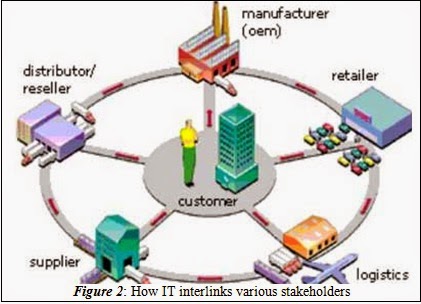
components resulting in a finished product, several suppliers and customers. Organizations
today need to adopt IT to support their supply chains and increase their
efficiency by achieving tighter cooperation over the supply-chain.
Technology has crept into Supply chain step by step, it
started with electronic invoicing, computerized shipping and tracking and
automated notifications that were initially used by companies for business to
business interactions and later on these features were passed on to the
consumers. Technology today has extensive capability when it comes to keeping
the production on track, anticipating and repairing mistakes and making
modifications that guarantee a top quality product. Every link in the supply
chain can be monitored simultaneously and automated notification systems are
highly valuable in sending messages to several players.
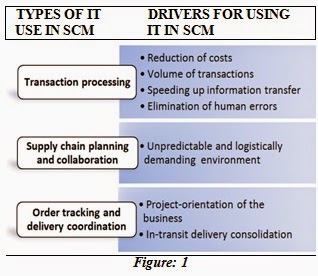
IT plays instrumental role in bringing together multiple
technologies and integrating them to optimize various scenarios in SCM. The Types
of IT available for optimizing Supply chain management are:
- Transaction processing: This IT is used for information exchange especially for tasks such as order processing, billing, delivery verification, sending dispatches and producing orders. IT is used for increasing the efficiency of information exchange between various supply chain partners.
- Supply chain planning and collaborating: This type of IT is used for forecasting changes in demand, inventory information and production capacity information. The use of IT in planning and collaborating is to improve efficiency and minimize waste along all components of the supply chain.
- Order tracking and delivery coordination: This type of IT is not only used by the businesses but also used by consumers to track individual shipments. Businesses use this technology to track final products or in-progress inventory to coordinate their timely delivery or determining information about their location.
Supply chain today provides increased visibility and
accountability and thus providing the organization with a stronger competitive
edge.
Supply chain related Apps and other related features on
smart phones, tablets and other mobile devices are adding portability to the
supply chain management. Tablets and smartphones today have longer battery
lives, keyboard functionalities, barcode scanning capability, high quality
digital cameras and speech recognition ability making them an ideal fit for the
warehouse operations. Wireless devices provide flexibility, mobility and
convenience that allows supply chain managers to coordinate processes at every
step in the chain without regards to its physical location. Software programs and cloud computing have
enhanced the tracking of products and provide real-time status updates at the
touch of a button. This allows companies to adjust their production schedules
and inventory levels on the go.
Four major business areas where supply chain management technology
play an important role are:
- Global Trade: Global trade involves several elements of uncertainty and changing regulations. Use of technology will keep everyone along the chain appraised of the latest updates and avoid stepping over regulations.
- Supply relationship management: Technology will help keep all the people involved in the supply chain within the loop. By making communication automated, everyone will be made aware of the disruption in the supply chain and allow individuals take timely action to mitigate risks. Thus technology will keep everyone informed and help manage the relationship.
- Reverse supply chain: When there is a sudden influx of new goods, manufacturers have to offload outdated goods quickly. Notification can help alert a variety of recyclers and other parties at once, allowing them to respond with times they are available to remove redistributed goods.
- Supply chain execution: Technology helps to smoothly execute the supply chain operations and allows everyone along the supply chain be prepared for the tasks. If an individual is unavailable it is easier to alert everyone to help save money and time.
The incremental use of IT is reducing the storage space
required at the “Global Distribution Centers” while mitigating the risk of out
of stock situations and back orders. The ideal situation would be sending the
goods directly to customers/retailers without stocking the goods.
This poses a question, should organizations with limited funds and cash availability invest in updating and incorporating technology in their supply chain or direct their limited funds in operations and optimizing their processes?
References:
http://www.mbaskool.com/business-articles/operations/2083-role-of-information-technology-in-supply-chain-optimization.html
http://www.supplychainbrain.com/content/general-scm/quality-metrics/single-article-page/article/how-technology-can-ease-supply-chain-management-and-mitigate-risk/
http://globalpurchasing.com/supply-chain/using-technology-improve-supply-chain-management
Will Technological Advances Shrink Global Supply Chains?
This weeks' McKinsey article talked about key technologies that can help producers lower costs as well as improve ability to customize products. While this article focused mainly on the future of mass customization, I was interested in learning more about the impact of these technologies on the global supply chain, and decided to do some research on this.
Currently, many of the goods we purchase are designed in one country, and produced in another (or, in some cases, many others). When looking at labels on clothing or electronics purchased in the United States, rarely is the manufacturing country the same. This represents a complex global supply chain, as we have discussed in class in regards to Apple products, whose pieces come from multiple countries.
In researching this topic, I found articles that suggest a de-globalizatin of supply chains as a result of technological advances. With a software-defined supply chain, an IBM Electronics report states that the "minimum scale required to operate and be cost competitive has declined by an average of 90 percent."[1] In addition to this decrease, the report noted that with the advent and increase usage of 3D printing, the majority of a product's components can be printed in one location, and easily assembled by a relatively inexpensive flexible robot. If both tasks can be accomplished in one location, cost can be reduced, thus increasing the appeal of localizing the supply chain.
An article on GigaOm gives the example of a simple hearing-aid, whose cost of production has significantly decreased due to a software-defined supply chain. 3D printing should further decrease the price of hearing-aids, and also have a significant impact on the supply chain. The same IBM report forecasts that while the supply chain for hearing aids today is national, and even perhaps global, by 2022, it will be localized to city level production.

[1]
While hearing-aids are a relatively small product, it is interesting to see the change, and forecasted change, in this device's production. Will this be a trend that we see in the future with larger and more complex products?
The concept of software-defined supply chains presents interesting questions about market competition and the future of global supply chains. 3D printing and the use of robots for assembly may eliminate the need for intermediary players in current supply chains, and companies will likely be able to design and produce products much more rapidly than they have in the past.
Will technological advances serve to simplify supply chains as we currently know them? Will software-defined supply chains have the power to reverse some of the outsourcing that is a staple of current supply changes? With the advent of 3D printing, artificial intelligence, and other complex technologies that take the place of human labor, it will be interesting to watch what happens to global supply chains, and if we do in fact see a trend towards smaller, more localized supply chains.
_______
References:
[1] https://gigaom.com/2013/07/21/todays-complex-global-supply-chains-are-poised-to-be-dismantled/
Sunday, September 28, 2014
Smart Phones on Wheels
Technological
innovation has always been a driving force in supply chain management.
Typically, businesses expect technological innovations to “bring them larger
market opportunities and bigger profits” (Rettig). Recently, companies have
embraced smart technology to streamline online web orders, delivery, billing
and customer service. Currently, smart vehicles are at the cutting edge of
smart technology.
In
its latest issue of “Technology Quarterly,” researchers at The Economist investigate the cutting-edge phenomenon of driverless
cars. Specifically, the article, “Smartphones on Wheels,” discusses the
technology that would enable driverless cars goods as public goods. In a
society dominated by driverless vehicles, individuals simply “summon” a vehicle
when necessary. After one individual arrives at his/her destination, the
vehicle heads off to its next client. In fact, glimpses of this new technology
are appearing in today’s society. For example, Google recently created a
bubble-shaped prototype of an autonomous car has been running Toyotas adapted
for driverless travel on Highway 101 in Silicon Valley for the past few years.
Similarly,
approximately 3,000 drivers in Ann Arbor, Michigan have had wireless Internet
connections fitted to their cars. These vehicles are referred to as “connected
cars.” These connections can be used to feed information to and from other
vehicles. For example, the system can ward a driver if there is a chance of
collision with an oncoming vehicle, to help reduce future accidents.
The
establishment of the connected car represents the coming together of
communications technologies, information systems and safety devices to provide
vehicles with an increasing level of sophistication and automation. However,
research involving smart cars has been primarily direct towards individual
private consumers. To me, it seems like this technology offers potential for innovation
in the world of supply chain management. However, many American’s remain
unaware of the full potential for this technology. For example, based on a 2014
Wall Street Journal Survey, almost 80% of those surveyed had heard of the idea
of smart car technology before (Ausick). In order to successfully integrate
smart technology into the business world, businesses will have avoid the initial
mistakes of Ariba by fully committing to integrating the new technology.
As
a starting point, William Cassidy examines the role of technology as it relates
to Home Depot’s supply chain and inventory strategies in article, “Home Depot’s
New Strategy tied to E-Commerce Growth.” According to Cassidy, Home Depot has
worked to increase overall sales through the development of a recent e-commerce
project and in-store mobile app. Home Depot is working to capitalize on recent
innovations in technology by blurring the lines between online and in-store
experiences. By allowing customers to purchase items directly online, the
company’s overall transportation costs have declined in recent years. However,
they have not considered making any changes to actual transportation methods.
If Home Depot is able to eventually integrate smart car technology into their
supply chains, they will be able to reduce costs even further. Specifically,
they will reduce costs associated with transportation workers and vehicle
safety initiatives.
Looking
forward, I wonder if the technology of smart cars can be applied to other
vehicles. Is there potential for smart-trains or smart-ships in the future? If
so, how will this apply supply chain management?
Additionally,
the creation of smart cars implies that humans as drivers become obsolete. How
will the overall economic conditions and un-employment rates be affected if
smart cars replace human drivers as mechanisms for moving inventory?
References:
http://sloanreview.mit.edu/article/the-trouble-with-enterprise-software/
Subscribe to:
Posts (Atom)