Friday, October 10, 2014

Boeing’s Long-term of Airplane Demand

Forecasting demand is the prediction of future performance based on available information about past performance, political as well as economic condition, competitors’ behavior and so forth. Devoting resources to demand forecasting allows companies to shape the supply chain strategy and guide long-term business planning, which contributes to their performance in the competitive markets and increases the likelihood of success. Therefore, forecasting demand can be applied to any industries, from petty retail trade to large chains, from business to manufacturing industry. The following discussion will be on the “Current Market Outlook(2014-2033)”, a long-term forecast of air traffic volumes and airplane demand of Boeing.

Given the significance of forecasting demand, it embraces numerous influential factors like economic growth, fuel prices, different modes of transport, competitors, and so forth.


Economic growth, as measured by GDP, is a crucial element in forecasting demand. An ascending economic condition indicates that the government could invest extra capital in the aviation industry, and customer spending will also increase due to robust income growth.
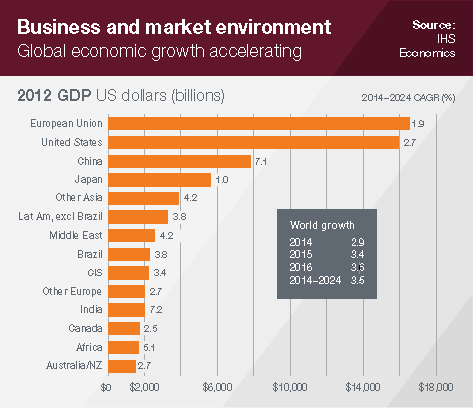
 As the major component of airline cost, fuel is an influential factor as well. The rise of fuel price together with technology development stimulates the manufacture of aircrafts with low energy, such as the 787 and the 737 MAX, which are more in line with market demand and thusly be highly consumed.

Moreover, different modes of transportation could also influence the future demand of Boeing.

The tremendous expansion of low-cost airlines spurs demand of airlines such as Boeing. Low-cost airlines typically means “operating at secondary airports, flying a single airplane type, increasing airplane utilization, relying on direct sales, offering a single-class product, avoiding frequent-flyer programs, and keeping labor costs low”. Compared to traditional carries, low-cost airlines reduce fares significantly and correspondingly stimulate traffic.

Air freighter is the other mode of transportation which is commonly used for shipments of high-value, time-sensitive, or perishable goods. As international trade has intensified and business scale has enlarged, demand for air freighter becomes more intensive and thusly request more airlines.
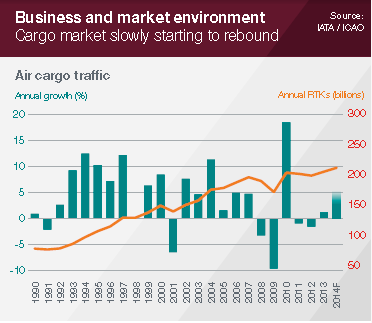
And for network carries, the primary mode of transportation, like American Airlines or ANA, the order is always constant without dramatic fluctuation to some extend.
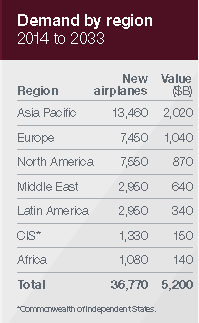
Apart from the above, there are few other elements that have impact on forecasting demand, including competitors, short-term effects like political issue and so forth. Under the combined effect of these factors, Boeing arrives at the conclusion that demand for 36,770 new airplanes, valued at $5.2 trillion. “15,500 of these airplanes will replace the older, less efficient airplanes. And the remaining 21,270 airplanes will be for fleet growth, which stimulates expansion in emerging markets and development of innovative airline business models. Single-aisle airplanes continue to command the largest share of the market. Approximately 25,680 new single-aisle airplanes will be needed over the next 20 years.”[1]
Question: Will Boeing and Airbus, the world's two largest aircraft manufacturing companies, share the same forecasting process and outcome?

Strategic Sourcing of the Siemens

    As companies nowadays are in a highly competitive and rapidly changing environment, it becomes increasingly difficult for firms to rely on the competitive advantages gained from sales and production processes. Yet the long-neglected purchasing department is still of great potential. Companies can gain sustainable competitive advantages through strategic sourcing by reducing the cost of investment and integrating suppliers’ ability.
        
    Siemens AG, a global powerhouse in the fields of electrification, automation and digitalization and for healthcare solutions[1], has achieved great success in the market of China. Looking into it, there are 4 principles of strategic sourcing inherent in Siemens.

1  Total cost consideration 
    Rather than merely consider price during procurement, Siemens makes strategic sourcing decision after combining different situations of suppliers and the demand of the company. That is to say, the amount of order depends on the total cost which embraces the price, quality as well as logistics. The lower the total cost, the smaller the share of orders. According to TCO model[2], price is not the ultimate payment, quantity, profit sharing, payment and even shipping should be included in the calculation of total cost as well.

2  Negotiation via fact and data
The success of strategic sourcing is partially based on negotiation via fact and data. To achieve this, the procurement department of Siemens sets up a marketing team to attract potential suppliers so as to recognize comparative advantages of the suppliers. In the process, they always look for new suppliers and evaluate them while cooperating with existing suppliers on brand-new areas.

3)  Supplier relationship management 
Improvements under supply chain management are established by the cooperation of purchasers and the suppliers. In addition, the investment of capital, resource, time and the introduction of new supply chain management thinking could also improve the efficiency of the supply chain and make direct economic benefits.
Implementation of supplier relationship management could be divided into three stages: at the very beginning, the company determines purchasing categories and savings target under certain suppliers. After that, a detailed flow of information should be established for answering questions related to performance. Finally, suppliers and purchasers should arrive at an agreement on the procedure in order for targeting desired consequence.

4)  Counterbalance
The relation between company and supplier is a mutual selection process. Therefore, fully understand the supplier and its business strategy, operational model, competitive advantage, operating conditions and stuff could create opportunities for company to find a balance point in mutual cooperation.
First, the audition of pre-production process could testify whether the supplier can produce to meet the quality requirements of Siemens. And then followed by a large-scale trial production, Siemens attempts to ensure the suppliers meet the six sigma quality standard and safeguard the stability of the manufacturing process. If it works, measurement systems could be established; but if not, Siemens will conduct an internal re-education for the suppliers.

In conclusion, Siemens are experiencing an efficient strategic sourcing management. But on the other hand, the prosperity of rivals does post a threat to the company. Is there any other strategic souring management measure to handle that? 


The Secret to Nordstrom’s Success: Inventory Management

During the U.S. recession, Nordstrom was outperforming its rivals like Macy’s and Saks. Shortly after the recession in 2009, its overall sales reached $8.26 billion[1]and its gain outpaced the 13 percent advance of the Standard & Poor’s 500 Retailing Index, while Saks had dropped 50 percent and Macy’s has lost 0.3 percent[2].

How could Nordstrom survive and thrive the recession? The secret is not involved a piercing insight into customers. Rather, it is inventory management that contributes to success.

Nordstrom introduces a single view of goods, which combines its in-store and online inventory systems, and displays stock from both the Web warehouse and its stores all at once. Say that if a customer is looking for a CK coat via Nordstrom.com, she can see whether the coat is available at nearby stores and reserve it for pickup the same day. More significant, ithe coat is out of stock on the web warehouse, you can still order it from any other regular stores.

By comparison, Wal-Mart can ship online items to nearby stores, and Target just displays items in different stores without selling them in advance.

However, inventory itself is a problem. Since there always exist incongruity among customer service, inventory-related costs and operation, maximizing customer service somewhat indicates expand inventory, and correspondingly increase cost. Therefore, Nordstrom make a trade-off between inventory and customers’ need by confining inventories to a stage where orders are well correspond with recent sales trends. If the sales of certain merchandise fell 4 percent in the previous 2 months, for instance, the order must be limited in the coming quarter.
The inventory management has significant impact on Nordstrom. The inventory turnover of Nordstrom shifted from 4.84 in 2005 to 5.41 in 2009, indicating that very little markdown should be performed late in the season. Under that circumstance, the company does not need to figure out an approach to maximize the profit by calculating relativity and relationship between the original one and the discounted one. Compared with the sale before the implementation of inventory management, Nordstrom sales have increased by 8 percent[3].


Therefore, the inventory management of Nordstrom is of great significance since it reduces costs as well as increases the efficiency.

But there comes a question, why other peers like Saks do not operate this way?


Lean Manufacturing and Toyota's Philosophy

Just-in-time (JIT) and lean manufacturing are vital concepts to modern manufacturing theories.  The goal of JIT is to save money in storage costs and produce and deliver products "just in time" to be sold (1).  The customer, rather than completing the sales cycle by buying the product, starts the cycle by ordering it and therefore creating the demand for manufacturing.

Toyota's lean approach to vehicle manufacturing has been adopted by almost every major car maker in the world.  The goal of the lean factories is to eliminate waste wherever possible (2).  Machines are not up and running if there is not a direct demand.  This saves money on raw materials, storage, labor, and overhead costs.  Everything that is in production has a direct demand associated.  By staying lean, Toyota has fewer inventories to worry about, and can focus on building quality vehicles.


http://www.gallus-group.com/ru/desktopdefault.aspx/tabid-318/473_read-910/


The lean philosophy has direct implications on their supply chains as well.  Keeping inventory levels low is central to the approach (3).  It reduces carrying costs, and by not overstocking, the company is able to get rid of cars that get outdated with minimal costs.  Embracing technology can also improve processes and reduce waste.  Technology will help monitor levels of inventory and shorten lead time by getting products to their destinations in the fastest time.  Technology can be used to better schedule and coordinate labor efforts as well.  It can diagnose and problems in lead times or low inventory levels, and help to correct the issues.

Lean philosophies can be applied to many other industries and settings, as many industries use similar processes and supply chain management systems.  One such setting is hospitals.  Hospitals have to coordinate spaces, people, and medical equipment and inventory to efficiently meet demand.  Many health systems are using lean approaches for their inventory management and improving processes.  Retailers with perishable goods benefit heavily from lean manufacturing and supply chain management also.  Grocery stores have to manage inventory of produce and meat to not overstock and sell the food before it goes bad.  Pharmacies have to sell their medications before they expire.  Lean manufacturing will help manage inventory levels to appropriately match customer demand.

Questions for further discussion:

What industries may NOT benefit much from lean approaches?
Is lean manufacturing sustainable for all car manufacturers?
How does a work or societal culture affect lean implementation?


Works consulted:
1) http://businesscasestudies.co.uk/exel/managing-the-supply-chain-for-globally-integrated-products/just-in-time-and-lean-production.html#axzz3Fm2zhgUi

2) http://scm.ncsu.edu/scm-articles/article/the-road-to-lean-manufacturing

3) http://www.beckershospitalreview.com/news-analysis/5-key-principles-for-hospitals-from-toyotas-lean-production-system.html

Forecasting Grocery Stores

Inventory management is the central and recurring theme for a successful supply chain.  By controlling inventory levels, supply chains are able to keep the appropriate amount of goods in stock and fulfill a customer's orders immediately as they come in.  Good inventory management hinges heavily on knowing the demand of customers and timeline of such expected orders.  This introduces the importance of forecasting in supply chains.

Forecasting is especially important in an industry with goods with a short shelf life, such as the grocery industry (1).  Grocers have to figure out how much of a product a customer will want at a specific time, make sure they will have it in stock, and not over-order to a point where they have to throw out a lot of the product if it goes bad.  Many fresh foods have a very limited shelf life; breads, meats, and produce all fall into this category (2).  Accurately forecasting customer demand of these products will ensure that customers will get the amount they are looking for, and that groceries won't have to throw out a large amount of excess stock.

The best way for a grocery store to forecast is to go on historical data (3).  As a food store is in business for a longer time, it can better assess what kinds of products people that shop there are likely to buy.  For instance, in a neighborhood that has a strong Asian community, traditional Chinese cooking ingredients will sell much more strongly than the ingredients would sell in a neighborhood that has a strong Indian heritage.  The store can adapt to the tastes of the surrounding community, analyze what quantities of what products will sell better, align their shelf space accordingly, and manage their subsequent inventory and orders based on sales.

Historical data can also come into play in seasonal forecasting.  Apple and pumpkin baked goods sell exponentially more in the months of September and October than any other time of year.  In being able to forecast customer demands, grocery stores are able to keep the right amount of stock for varying demands throughout the course of the year.

By accurately forecasting customer demand, grocery stores will be able to allot the appropriate shelf space to certain products.  They will save money on not throwing out expired products, be able to order the right amount of products from farmers, distributors, and manufacturers, and save money on shipping and shelving costs.  A grocery store that can forecast customer demand will be able to save money on inventory, and ultimately become much more profitable.

Questions for further thinking:

What types of products are harder to forecast demand?
How do you keep up with a neighborhood's changing tastes?
How do you extend the shelf life of products that can go bad?
What's more costly: to not order enough of a product, or to order too much?


Works consulted:

1) http://www.manh.com/industries/retail/grocery

2) http://www.choicesmagazine.org/2005-4/supplychain/2005-4-14.htm

3) http://smallbusiness.chron.com/demand-forecasting-estimation-32783.html


Wednesday, October 8, 2014

It is not just a toy maker—3D Printer

It is not just a toy maker—3D Printer

Post for Week 7Yvonne Zhang

The video “Make Your Own Products: 3D Printing Reaches Consumers” shows the fascinate implementation of 3D printers to build models and toys. One model, which traditionally needs to be built for days, will only take hours by 3D printing technology. However, the usage of 3D printing technology is not only limited to build toys. Being developed in 1980s, the 3D printing technology just got people’s attention in recently years due to the lower cost and improvement of technology. There are several kinds of product can be built by 3D printers.

  • Body Parts. Ears, Kidneys, Blood Vessels, Skin Grafts and Bones can be printed by using high-density gel or powder. Hundreds and thousands people need to replace parts of their body each year. Traditional replacement of body parts are hard to successfully incorporate into the body. The new technology will build the body parts with human cells and avoid the rejection.
  • Food. NASA has founded $125,000 grant on 3D printers to make food for astronauts and started with pizza. Multiple materials will be put on the plant by sequence and heated when printing. The creator of this 3D food printer aims to solve the problem of increasing food shortages and cutting down waste.
  • Cars. GM has already used 3D printing technology to build and test the parts of the car. They even use this technology to scan broken parts of the car in the catastrophe and quickly build the parts to replace them. 3D printing can also be used to create all the parts they need and build an entire car. Urbee 2 is the first car which is built by 3D printing technology. It is relatively cheaper and more energy efficiency than traditional cars.
  • Guns. Firearms can also be built in 3D technology if you have a printer and download the model from the internet. Recently, a computer controlled 3D gun printer, which can build aluminum body of gun without regulation and serial numbers, were sold out in 36 hours. Each of them is worth $1,200. It has raised a new issue about gun control, because each one can build their own gun in home and without tracking from government. People worried that this this technology and machine would be misused by criminals.

It is obvious that 3D printing technology has found its position in the industrial sector, especially for manufacturing. It could significantly reduce the time to make product because there is no need to wait for weeks or months for modeling, which would shorten the supply chain and product life cycle. However, there is another question, how about the implementation of 3D printer in daily life? Do people really need it currently? Some people would say they can make their own materials and furniture in home. But if I can order the product from Amazon or IKEA by two-day delivery, why I need to purchase this expensive machine and make it myself? Maybe it is still a fiction for people to widely use 3D printers. The question left for producers is that how could they motive people and make them believe they really need it and want to use it?


References:
Carney, Dan 2013, 3D Printing Can Now Re-create an Entire Classic Car, Popular Mechanics, http://www.popularmechanics.com/cars/news/vintage-speed/3d-printing-can-now-re-create-an-entire-classic-car-15566080
Leckart, Steven 2013, 5 Body Parts Scientists Can 3-D Print, Popular Science, http://www.popsci.com/science/gallery/2013-07/5-body-parts-scientists-can-3-d-print/?image=0
Orsini, Lauren 2014, 10 Crazy Things 3D Printers Can Make Today, ReadWrite, http://readwrite.com/2014/02/14/3d-printing-printers-projects-applications-prints
Souppouris, Aaron 2013, NASA is funding a 3D food printer, and it'll start with pizza, The Verge, http://www.theverge.com/2013/5/21/4350948/nasa-funding-3d-food-printer-pizza

Tea Party 2014, $1,200 Machine for 3D-Printing Guns Sells Out, Tea Party, http://www.teaparty.org/1200-machine-3d-printing-guns-sells-59467/

Alibaba—Ecommerce Giant in China

Alibaba—Ecommerce Giant in China

Post for Week 6
Yvonne Zhang

China has already been known that has the largest online population, which also stimulates the online shopping. In 2013, China had $296.57 billion online retail sales in total, which increased 41.2% compared with 2012. China has passed the US to become the largest ecommerce market in the world. Based on the report from the Ministry of Commerce in China, the total ecommerce in 2013 was $1.6 trillion, including transactions between companies.

The rapid growth of ecommerce in China is driven by new technology and innovative business models. One of the market dominant players, Alibaba which just went public in New York Stock Market on September 19, has created a unique ecommerce model and proved to be a success. It has two largest online shopping platforms, Tmall and Taobao, and one B2B wholesale platform which has just been built. Somebody said Tmall and Taobao were Chinese Amazon and Ebay. However, it is not quite accurate. Tmall and Taobao don’t have their own warehouses, delivery channel and supply chain system. They only offer a platform for individual sellers to manage their business and monitor the delivery and transactions. Each individual seller has its own supply chain, from source, inventory, and delivery to customer services.

Taobao is created for small and middle scale companies or individuals who don’t have enough money to open a physical store. It is totally free to open a store on Taobao. Tmall is like a virtual shopping mall and usually registered by large scale companies which don’t want to build its own ecommerce platform. They have to pay annual fee for registration, but usually they will provide qualified product and better customer services. Unlike Amazon and Ebay, which specialize in customer-facing goods not business supplies, Alibaba launched its first B2B platform in the US in 2009 to link the customers in North America and Europe with the suppliers in China. Buyers can place orders directly on the website and companies have no need to prepare paper orders or invoices. The wholesale business in Alibaba accounted for 11.8% of its total revenues in 2014, and most of them are from buyers outside of China. This B2B platform has been a new method for global transactions that companies can connect with manufacturers before doing business and people don’t have to travel to another country to do business.

However, there are questions raised along with the prosperity of ecommerce. Even though the ecommerce is more convenient for consumers, some people are still like face-to-face services. It is difficult to check the quality through ecommerce or online shopping, which is the biggest problem with Tmall and Taobao platform. Besides, unlike Amazon, each individual seller on Tmall and Taobao has to manage their own supply chain, which is hard to guarantee the efficiency of the process and quality of service, especially for those sellers who don’t have experience of supply chain management. So the question is which is the most effective and efficient way to manage the ecommerce, like Amazon or Alibaba? Since Amazon started its business in China, will its ecommerce model adapt the Chinese market? And how could ecommerce platforms to face the demand driven market in the future to fulfil the customers’ demand?


References:
Griffith, Erin 2014, In B2B e-commerce, Alibaba has solved the one problem Amazon can't, Fortune, http://fortune.com/2014/09/08/alibaba-amazon-b2b-ecommerce/
Hanks, Jeremy 2013, Evolving The Supply Chain in the Ecommerce Age, MultiChanelMerchant, http://multichannelmerchant.com/opsandfulfillment/warehouse/evolving-the-supply-chain-in-the-ecommerce-age-12082013/
TONG, FRANK 2014, China officially passes the U.S. in e-commerce, Internet Retailer, http://www.internetretailer.com/2014/05/29/china-officially-passes-us-e-commerce
TONG, FRANK 2014, Chinese e-commerce giant Alibaba builds its B2B business, Internet Retailer, http://www.internetretailer.com/2014/04/15/chinese-e-commerce-giant-alibaba-builds-its-b2b-business

Wertz, Boris & Contributor, Guest 2013, Alibaba is just the beginning: How B2B marketplaces will thrive (for real, this time), GIGAOM, https://gigaom.com/2013/06/30/alibaba-is-just-the-beginning-how-b2b-marketplaces/

Data Analytics to build solutions

"Its all about getting close to your customer! "

What do customers want / look for in a product? How do you inspect goods from suppliers? How do you hit the performance targets?  How do I innovate my product? How do I visualize my profit margins?

A lot of these questions today are answered by Big Data.

Value for business analytics for solving complex supply chain issues has increased in terms of investing more on ERP systems for planning and execution. Getting information for measuring and diagnosing problems in supply chains to meet targets and benchmarks are crucial for improving customer relations.

Dashboards and reports for optimizing costs, measuring key performance indicators for executives and board room to those working on the shop has brought the company workers closer as well as providing better service to their customers.

Back office functions and in general the normal operations in a company can lead to a lot of data presented but without leading anywhere on how relevant they are for decision making.

Forecasting accuracy, days still outstanding, inventory days of supply all are key performance indicators which an executive should look into. and with business intelligence and data analytics, these are better presented with interactive dashboards.

Having worked in IBM B2B  for three years, I can take pride in saying that I worked on predictive analytics for dashboard maintenance for tracking the number of customer defects a company addresses. This taught me a lot about customer demand , understanding causality and predicting trends and evaluating performance.


Analytics as you can see in the above graph increases the supply chain visibility. The operations of the company enhances along with sales and manufacturing by focusing on financial planning, demand planning and supply planning and analytics integrates all of these together. These supply chain metrics can be very insightful in operational level such as functional/departmental issues like procurement.

The huge success of analytics has happened through the transaction systems for ERP, supply chain planning and implementation systems and CRM systems for getting reviews of the customer.

https://www.youtube.com/watch?v=Vpw2RdQtY7s

https://www.youtube.com/watch?v=vY522OaR2Ro

The Disruptive Bang Theory

The American manufacturing industry is expected to resurge, as a result of new technologies and approaches. The resurgence is gladly welcomed and comes at a much-needed time. Manufacturing employment in America has fallen by a third in the last decade, with more than 40,000 factories shutting down. [i] This is fairly correlated with the shift away from Americans making things to American companies—big firms and start-ups alike—outsourcing much of their “making” overseas. And while this trend has been progressively popular over the years, it is anticipated that Americans will make things again, but in a different way. “Making” will not only take place in factories, it will also be done in homes, and not for the reasons you may think—artisanal or faddish. “Making” in the home will become adopted because of its ease, positive environmental externalities, and fun.  What was once only capable for big firms with hulking factories to complete now can be done in a home-basement or by emailing a design to a machine. Congruently, it is also anticipated that companies (mid and smaller sized) will also adopt these new technologies and approaches.

Highly adaptive, low-cost robotics is making manufacturing operations less sensitive to the cost of human labor.[ii] As more automation capabilities are introduced within this sector the common practice of offshoring solely to access cheap labor will become unappealing. Increasingly, the scalability of additive manufacturing, will allow companies to “design distributed manufacturing operations that scale with the market they serve.”[iii] Companies now can make things at the point of use and need. A particularly advantageous approach for smaller companies, because now they can remain competitive—reducing their capital investment costs.  In energy intensive industries (cement and chemicals) the proliferation of hydraulic fracturing has brought cheap domestic energy—lowering costs.[iv]  On the horizon the use of new biological methods of manufacturing materials or compounds have the potential to lower the amount of energy use required in certain sectors. All of which will result in years of company savings across the industry. Companies are currently experimenting with the concept of “continuous manufacturing process, ”[v] which replaces the need to “make things” in discrete, costly, and inefficient batches. Once this approach becomes increasingly popular, fair amounts of operation savings are anticipated.  Moreover, the implications of this resurgence are that companies will experience lessened sensitivity to human labor costs, reduced capital investment and energy costs, and increased invention to production efficiencies.

Although these anticipated shifts signify manufacturing operation advancements, it is essential to maintain a watchful eye on the various components of supply chains that can become disrupted. For example, automation through robotics can remove the human labor force completely, and natural oil and gas while it allows for cheaper energy consumption there are environmental and social costs. Therefore it is necessary for companies and the manufacturing industry as a whole to take stock of the anticipated trade-offs of implementing new technological approaches for operation.  I invite you to chime in. Where should companies draw the line when adopting new manufacturing technologies and approaches?


[i] The Kitchen Table Industrialists (New York Times, May 13, 2011)
[ii] The 4 Technology Trends That Could Bring Back U.S. Manufacturing (and Innovation) (Fast Company, September 27, 2013)
[iii] The 4 Technology Trends That Could Bring Back U.S. Manufacturing (and
Innovation) (Fast Company, September 27, 2013)
[iv] The 4 Technology Trends That Could Bring Back U.S. Manufacturing (and
Innovation) (Fast Company, September 27, 2013)
[v] The 4 Technology Trends That Could Bring Back U.S. Manufacturing (and
Innovation) (Fast Company, September 27, 2013)